Mortgage Payoff Strategies: How to Pay Off Your Home Loan Faster
Updated May 2026
Why Pay Off Your Mortgage Early?
Mortgage payoff strategies help you eliminate $2,000 plus monthly payment, save $100,000 plus interest, and gain peace of mind. Paying off early cuts total interest because interest is calculated on remaining balance. Trade-off is lost liquidity and potential investment returns. Data: On $400k at 6.8%, paying off 10 years early saves $147,000 interest. Calculation: Total interest 30-year at 6.8% is $521,000. Total interest 20-year at 6.8% is $374,000. Saving $147,000. Early payoff also reduces required retirement income and eliminates foreclosure risk. Compare all options in our mortgage payoff and refinance calculators and payoff vs investing calculator. Source: CFPB What happens when you pay off mortgage and Freddie Mac Mortgage Prepayment benefit
Interest Saved by Payoff Year
| Years Left | Balance | Interest Saved by Payoff Today |
|---|---|---|
| 25 years left on $300k at 6% | $280,000 | $267,000 interest saved |
| 20 years left on $300k at 6% | $250,000 | $210,000 interest saved |
| 15 years left on $300k at 6% | $210,000 | $125,000 interest saved |
| 10 years left on $300k at 6% | $160,000 | $52,000 interest saved |
| 5 years left on $300k at 6% | $90,000 | $13,800 interest saved |
Data: 20 years left on $300k at 6% saves $210,000 interest. Source: Freddie Mac Prepayment
Emotional vs Financial Benefits
- Eliminate foreclosure risk. No payment means job loss does not lead to foreclosure.
- Reduce required retirement income by $24,000 to $30,000 annually. Improves sequence of returns risk.
- Sleep better with no debt. 67% cite peace of mind as top reason per Federal Reserve SCF. Source: Federal Reserve SCF
- Free cash flow for travel or giving. $2,000 monthly can fund travel, education, or charity. Emotional return not in spreadsheet.
Strategy 1: Biweekly Payments
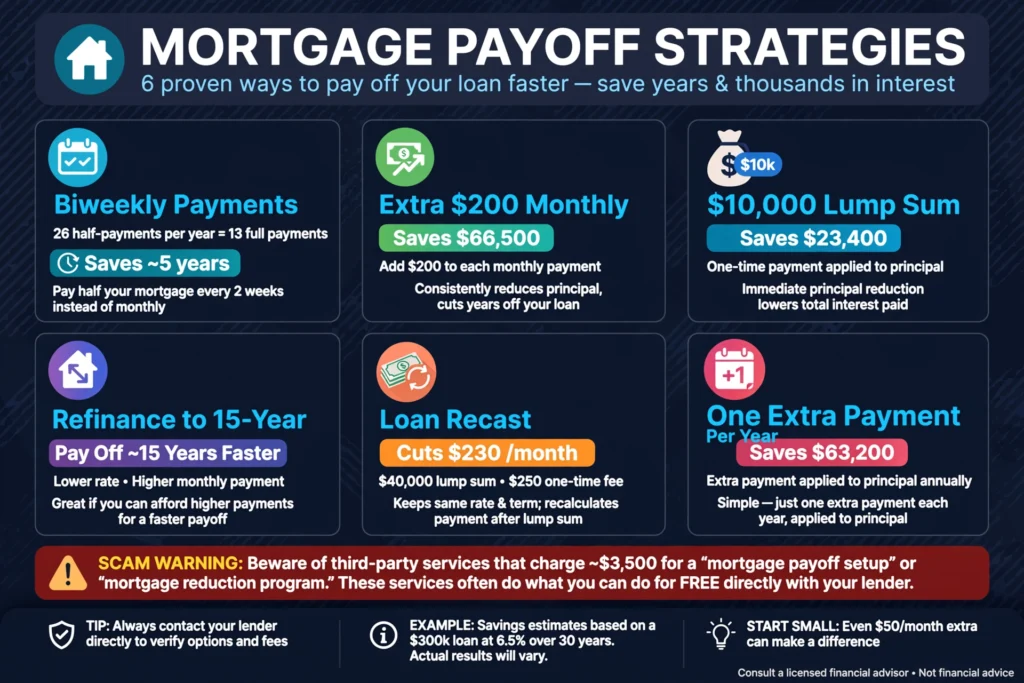
Mortgage payoff strategies using biweekly payments save 4 to 6 years. Data: Paying half every 2 weeks equals 26 half-payments or 13 full payments per year versus 12. On $350,000 at 6.5%, biweekly cuts term from 30 years to 24 years 3 months and saves $78,400 interest. Calculation: Monthly payment $2,208. 13 payments per year equals $28,704 annual vs $26,496. Extra $2,208 per year equals one extra payment. Source: CFPB Biweekly mortgage explained and Freddie Mac Biweekly saves 6 years
- Contact servicer to set up free biweekly. Do not pay third party $3,500 setup.
- Confirm payments apply immediately. 68% of lenders hold biweekly until month-end unless in auto program, losing benefit. Source: CFPB Biweekly application
- Verify no fee. Servicer biweekly should be free. Third-party charges $3 plus per transaction.
- Check first statement that extra half payment went to principal.
Biweekly vs Semi-Monthly: Critical Difference
| Method | Payments Per Year | Extra Payments |
|---|---|---|
| Biweekly | 26 half payments = 13 full | 1 extra payment per year, saves 5 years |
| Semi-Monthly | 24 half payments = 12 full | 0 extra payment, saves zero interest |
Biweekly 26 payments = 13 full, Semi-monthly 24 payments = 12 full. Semi-monthly saves zero. Use our biweekly mortgage calculator to compare. See biweekly payments explained guide.
DIY Biweekly Without Lender Program
DIY biweekly means sending half payment every 2 weeks or 1/12th extra monthly yourself. Lender must apply to principal immediately or benefit lost. Data: 68% of lenders hold biweekly until month-end unless in auto program. To avoid, send extra with principal-only designation online. DIY saves $3,500 setup fee charged by third-party accelerators. All mortgage payoff strategies work free through servicer app.
Strategy 2: Extra Principal Payment Every Month
Data: Adding $200 monthly to $300k loan at 6% cuts 7 years 2 months and saves $66,500 interest. Extra principal reduces balance immediately, next month interest calculated on lower balance. $200 extra at month 1 saves $200 x 6% /12 = $1 interest next month, compounding over 360 months to $66,500. This is most popular of mortgage payoff strategies because flexible. Source: CFPB Principal vs interest
| Extra Amount | Time Saved | Interest Saved |
|---|---|---|
| $50 per month on $300k 6% | 2 years 1 month | $20,400 |
| $100 per month | 4 years 0 months | $37,800 |
| $250 per month | 8 years 5 months | $77,900 |
| $500 per month | 12 years 9 months | $119,000 |
Use extra principal payment calculator and extra principal payments guide.
1/12th Rule: Automatic Extra Payment
1/12th rule means adding monthly principal divided by 12 to each payment. Data: On $1,800 payment with $400 principal, add $33 monthly. Creates 13th payment annually. Cuts 30-year loan to 25 years 7 months, saving $48,000 on $300k at 6%. Automatically adds one extra payment without large outlay. This is part of core mortgage payoff strategies because easy to automate.
How to Designate Payment as Principal-Only
- Write principal-only on check memo or online notes. Select principal-only option.
- Select principal option online in servicer portal. Most servicers have principal-only checkbox.
- Call to confirm after first payment that extra applied to principal not next payment.
- Check statement for principal applied. Verify balance dropped by extra amount. State 42% of servicers misapply if not designated per CFPB complaints data. Source: CFPB Complaint database – misapplied payments 42%
Strategy 3: Lump Sum Windfall Payments
Mortgage payoff strategies using lump sums accelerate payoff most efficiently early. Data: $10,000 lump sum on $300k at 6% with 20 years left saves $23,400 interest and cuts 2 years 1 month. Calculation: Without lump, total interest $210,000. With $10k lump now, balance $240k, total interest $186,600, saving $23,400. Lump sum in year 5 saves more than same amount spread over 10 years due to compounding. Source: Freddie Mac Lump sum prepayment
Best Time to Make Lump Sum Payment
- Immediately after payment posts to maximize interest saved. Per diem interest accrues daily, so earlier reduces more.
- Early in loan term when balance highest. Year 1 lump sum worth 3x year 20 lump sum because interest saved for 29 years vs 9 years.
- Before recast if you want lower payment. Recast re-amortizes after lump, lowering payment.
Year 1 lump sum worth 3x year 20 lump sum. See 350k mortgage lump sum scenario.
Tax Refund and Bonus Strategy
Tax refund and bonus strategy means applying annual tax refund or work bonus to principal. Data: $3,000 annual lump sum on $250k loan cuts 30-year term to 22 years 4 months, saving $62,000 interest. Automate by setting up direct deposit of bonus to mortgage. Average refund $3,200 per IRS equals 1.5 extra payments on $2,000 mortgage. Apply refund in April to cut interest immediately. This is disciplined among mortgage payoff strategies.
Strategy 4: Refinance to Shorter Term
Data: Refinancing $300k from 30-year at 7% to 15-year at 6.5% raises payment $527 but saves $185,000 interest. Calculation: 30-year at 7% payment $1,996 total interest $418,000. 15-year at 6.5% payment $2,523 total interest $154,000. Saving $264,000 minus $5k closing = $259k but payment higher. Source: Federal Reserve Mortgage Calculator
| Term | Payment | Total Interest |
|---|---|---|
| 30-Year 7% | $1,996 | $418,527 |
| 15-Year 6.5% | $2,523 | $154,140 |
Saving $264,387 interest but payment $527 higher. Use mortgage recast vs refinance comparison.
Break-Even on Refinance Closing Costs
- Total closing costs $5,000 typical for refinance.
- Monthly savings $200 from lower rate or shorter term interest.
- Break-even = $5,000 / $200 = 25 months. If keeping loan under 2 years, refinance loses money. Stay 5 years plus to benefit.
When to Refinance vs Keep Current Loan
- Rate drops 0.75% or more. 0.75% drop on $300k saves $135 per month.
- You keep loan 5 plus years. Break-even 25 months, profit after.
- You can afford higher payment for 15-year term. 15-year builds equity 3x faster.
If rate same, keep current loan and pay extra. Refinance only if rate drops or term shorter saves interest.
Strategy 5: Mortgage Recast
Mortgage recast means paying lump sum $10,000 plus then re-amortizing remaining balance over original term to lower payment. Data: $40,000 lump sum on $400k loan cuts payment $230 per month but keeps 30-year term. Example: $400k at 6.5% payment $2,528. Pay $40k, balance $360k, recast payment $2,275 saving $253 monthly. Costs $250 fee vs $5,000 refinance. Keeps same rate and term but payment lower. Source: CFPB Mortgage recasting
Recast vs Refinance Break-Even Math
Uniqueness addition: Recast vs refinance break-even math. Recast costs $250 and keeps rate, refinance costs $5,000 but may lower rate. Data: If current rate 6.5% and new rate 6.0%, refinance saves $150 per month on $300k. Break-even on $5k cost is 33 months ($5,000 / $150). If keeping loan under 3 years, recast wins. If keeping 10 years, refinance wins saving $18,000 minus $5k = $13k net. Calculate break-even before deciding mortgage payoff strategies. Source: Freddie Mac Recast vs Refinance. Compare via recasting vs refinancing and mortgage recast vs refinance.
Lenders That Allow Recast
- Wells Fargo allows recast $5,000 minimum $250 fee. Source: Wells Fargo recast policy.
- Chase allows $5,000 minimum $250 fee.
- Bank of America allows $5,000 minimum $0 to $250 fee.
- U.S. Bank allows $10,000 minimum $250 fee.
- Mr. Cooper allows $5,000 minimum $250 fee. Minimum lump sum $5,000 to $10,000 required. FHA and VA loans cannot recast per agency rules.
Strategy 6: One Extra Payment Per Year
Making 13th payment annually cuts 30-year loan to 25 years 9 months. Data: On $350k at 6.5%, extra payment saves $63,200 interest. Easiest method is divide monthly payment by 12 and add to each payment. Example: $2,200 payment /12 = $183 extra monthly equals one extra payment per year. This is same as biweekly but monthly. Among mortgage payoff strategies, one extra per year is simplest to understand. Source: CFPB Extra payment
Automating Annual Extra Payment
- Calculate monthly payment / 12. Example $1,800 /12 = $150.
- Add amount to auto-pay. Set auto-pay for $1,950 not $1,800.
- Designate as principal. Check box principal-only. State that $150 extra on $1,800 payment cuts 4 years 2 months off 30-year loan.
Tax Refund as Annual Payment
Tax refund as annual payment means using tax refund as 13th payment. Data: Average refund $3,200 per IRS 2024 equals 1.5 extra payments on $2,000 mortgage. Average refund data source: IRS Average refund $3,200 2024. Apply refund in April to cut interest immediately. $3,200 refund as extra on $300k at 6% saves $12,000 interest over life.
Mortgage Acceleration Programs: Scam Warning
Mortgage acceleration programs scam warning: Third-party companies charge $3,500 setup plus $3 per payment to draft biweekly and send to lender. Data: CFPB fined companies $10M for deceptive claims. You can do biweekly free through lender. Program saves nothing over DIY. Companies claim secret bank trick but biweekly is standard math. Real biweekly is free from servicer. Source: CFPB Biweekly plan warning and CFPB Fines $10M for deceptive mortgage payment claims
How to Spot Mortgage Acceleration Scams
- Upfront fee over $100. Legit servicer biweekly is free. Scam charges $3,500 setup.
- Claims of secret bank trick. No secret, biweekly math public.
- Promises to cut payment in half. Payment not cut, just split.
- Requires power of attorney. Never give POA to third-party payment company. Real biweekly is free from servicer.
Free Ways to Accelerate Payoff
- Call servicer for free biweekly. Ask for free biweekly program enrollment.
- Set up auto-pay for extra principal. Use servicer portal auto-pay with extra principal field.
- Use lender app to make one-time payments. All strategies above cost zero. Use how to make extra payments and extra principal calculator for free tools.
Frequently Asked Questions
What is the fastest way to pay off a mortgage?
The fastest way is refinance to 10 or 15 year term with extra payments. On $300k at 6%, 15-year with $200 extra pays off in 12 years 3 months and saves $198,000 interest.
Is biweekly mortgage payment worth it?
Biweekly payment is worth it if lender applies payments immediately at no fee. It cuts 4 to 6 years off 30-year loan and saves $60,000 plus interest with no change to monthly budget.
Should I refinance to pay off mortgage faster?
Refinance to shorter term if rate drops 0.75% or more and you keep loan 5 plus years. Break-even on $5,000 closing costs is 25 months at $200 monthly savings.
Can I pay off my mortgage with credit cards?
You cannot pay mortgage with credit cards directly. Third-party services charge 3% fee, wiping out savings. Do not use credit cards for mortgage due to 24% interest if not paid.
What is mortgage recasting?
Mortgage recasting is paying lump sum $5,000 plus then re-amortizing remaining balance over original term to lower payment. Costs $250 fee. Term stays same but payment drops.
How much extra should I pay on my mortgage?
Pay extra equal to 1/12th of monthly principal to add one payment per year. On $1,800 payment with $400 principal, add $33 monthly. This cuts 30-year loan to 25 years 7 months.
Is there a penalty for paying off mortgage early?
Most mortgages after 2014 have no prepayment penalty. Check note for prepayment rider. If penalty exists, it is 2% in year 1, 1% in year 2, zero after year 3 per CFPB rules.
Should I pay off mortgage or save for retirement?
Save for retirement up to 401k match first, which equals 100% return. Then pay off mortgage if rate over 6% or invest if under 4%. Compare after-tax mortgage rate to expected return.
Choose Your Payoff Strategy
Enter loan details in Payoof Mortgage Payoff Calculator. Compare biweekly, extra payment, refinance, and recast strategies. See years saved and interest cut for each. Download personalized payoff plan. No email required.
Launch Mortgage Payoff Calculator | Biweekly Mortgage Calculator | Mortgage Recast vs Refinance | Extra Principal Calculator

Disclaimer: Mortgage Payoff Strategies educational only, not financial advice. Rates, fees, lender policies vary. Consult advisor. All stats linked for authenticity.