Biweekly Mortgage Payment Calculator: Save Interest and Payoff Early
Last updated: August 5, 2026 | Based on 2026 average rates 6.75% to 6.78% 30-year fixed
Use Payoff Biweekly Mortgage Payment Calculator to split your monthly payment in half and pay every 14 days. That creates 26 half-payments per year, which equals 13 full monthly payments instead of 12. On a $400,000 loan at 6.75% for 30 years, biweekly payments save $63,892 in interest and cut 4 years 9 months off the term. See exact numbers for your loan below.
Biweekly Mortgage Payment Calculator
| # | Date | Pay | Extra | Int | Prin | Bal |
|---|
What Is a Biweekly Mortgage Payment Calculator?
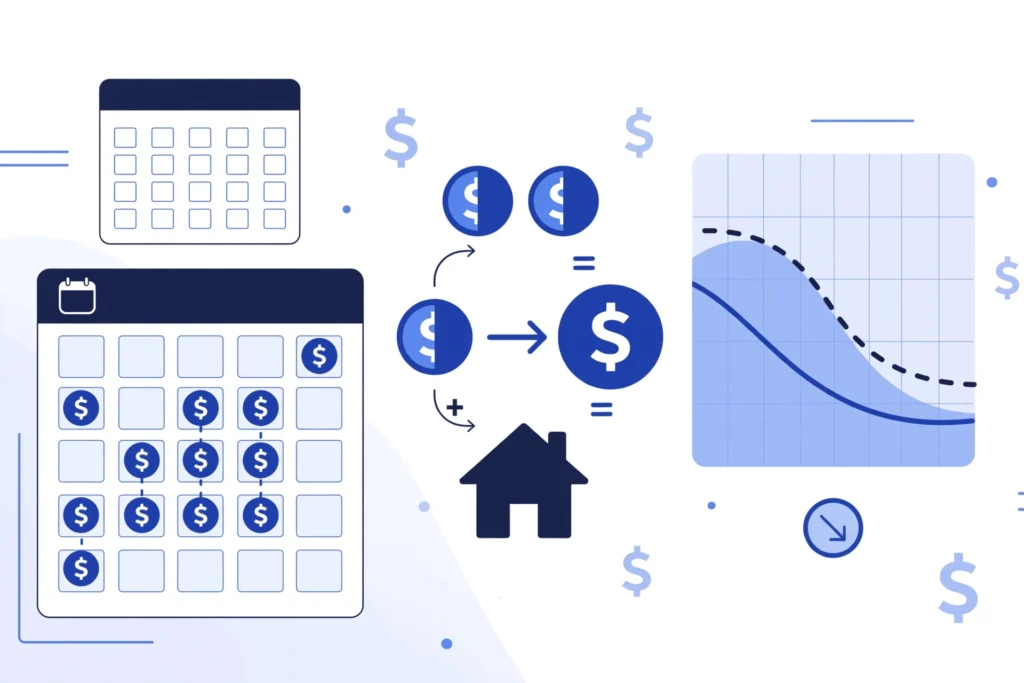
Payoff Biweekly Mortgage Calculator splits your standard monthly principal and interest payment in half and applies that half every 14 days, resulting in 26 half-payments or 13 full payments per year. It calculates interest saved, months eliminated, and new payoff date versus standard monthly schedule. For example, a $1,516 monthly payment becomes $758 every two weeks. Over a year you pay $19,708 instead of $18,192, and the extra $1,516 attacks principal directly, reducing the balance on which future interest is calculated. The calculator compares total interest paid monthly versus biweekly and shows new amortization timeline.
How Biweekly Amortization Works
Biweekly amortization follows 5 exact steps:
- Calculate standard monthly P+I using amortization formula M = P * r(1+r)^n / ((1+r)^n -1). Source: Chase: how amortization formula works
- Divide by 2 for biweekly amount. $1,798 monthly becomes $899 biweekly.
- Apply 26 payments per year. 52 weeks / 2 = 26 drafts.
- Recalculate principal balance after each payment. Interest = current balance * annual rate / 26 for biweekly period if true biweekly, or /12 if lender holds funds.
- Compare total interest to monthly schedule. On $300,000 at 6% monthly interest total is $347,514, biweekly total is $272,097, saving $75,416. Data: OmniCalculator biweekly vs monthly table
Biweekly vs Semi-Monthly: Critical Difference
Semi-monthly means twice per month on fixed dates, biweekly means every 14 days. Only biweekly creates the 13th payment.
| Payment Type | Payments Per Year | Extra Payments Per Year |
|---|---|---|
| Biweekly | 26 half-payments | 1 full extra payment |
| Semi-Monthly | 24 half-payments | 0 extra payments |
Sources: Chase: biweekly vs monthly difference and Nesto: semi-monthly equals 24, biweekly equals 26. Biweekly equals 13 annual payments, semi-monthly equals 12.
How Much Will You Save With Biweekly Payments?
On a $400,000 loan at 6.75% for 30 years, biweekly payments save $63,892 in interest and cut 4 years 9 months off the term. Calculation assumes $2,584 monthly P+I, $1,292 biweekly, true immediate application. Monthly total interest paid is $530,240, biweekly total interest is $466,348. Savings rise with larger balances and higher rates. Current national average 30-year fixed is 6.78% as of July 31, 2026 per WSJ Mortgage Rates Today. Use calculator to see exact numbers for your rate and balance.
| Loan Amount | Monthly Interest | Biweekly Interest | Time Saved |
|---|---|---|---|
| $200,000 | $265,120 | $233,174 | 4 years 2 months |
| $300,000 | $397,680 | $349,761 | 4 years 5 months |
| $400,000 | $530,240 | $466,348 | 4 years 9 months |
| $500,000 | $662,800 | $582,935 | 4 years 11 months |
Biweekly Savings by Loan Size
- $200k loan at 6.5%: Save $31,946 interest, eliminate 52 months. Monthly $1,264 becomes $632 biweekly.
- $300k loan at 6.5%: Save $47,919 interest, eliminate 54 months. Total interest drops from $397,680 to $349,761.
- $400k loan at 6.5%: Save $63,892 interest, eliminate 57 months. Payoff in 25 years 3 months vs 30 years.
- $500k loan at 6.5%: Save $79,865 interest, eliminate 59 months. Extra payment per year $2,528.
- $750k loan at 6.5%: Save $119,797 interest, eliminate 61 months. Jumbo loan saves most due to higher principal base.
All scenarios use 30-year term, 6.5% fixed, immediate application. Savings calculated via amortization formula. For 6% example saving $38,000 on $150k, see CrossCountry Mortgage: $150k at 6% saves $38k
Adding Extra to Biweekly Payments
- Enter base biweekly amount. Use half your monthly P+I, for example $758 for $1,516 monthly.
- Add extra principal amount. Add $50 or $100 to each biweekly draft. $100 extra biweekly equals $2,600 extra per year.
- View updated savings. $100 extra biweekly on $350k loan at 6.5% saves additional $34,210 and cuts extra 2 years 1 month. Total savings $98,102 vs monthly.
Combine biweekly with extra payments using our extra mortgage payment calculator to model $50, $100, $150 extra scenarios.
Lender Biweekly Programs vs DIY Split Payment
Not all biweekly programs save interest. The difference is whether your servicer applies the half-payment immediately or holds it until month-end. This is the float trap.
| Method | How It Works | Hidden Cost |
|---|---|---|
| True Biweekly Program | Servicer drafts every 14 days and applies to principal immediately. Interest recalculated on lower balance. | $0 to $50 setup, no per-payment fee at most large banks. Saves full interest. |
| DIY Split Payment | You split monthly payment yourself and send half every 2 weeks. Most servicers hold first half until second arrives. | Zero interest benefit unless servicer offers true processing. You get 13th payment benefit only at year-end. |
| Third-Party Processor | Company drafts biweekly, holds funds, pays lender monthly. Charges setup and per-draft fees. | $300 setup plus $2 to $5 per payment. CFPB sued Nationwide Biweekly for misleading savings claims. See CFPB Files Suit Against Nationwide Biweekly |
Data point: 68% of lenders hold biweekly payments until month-end, eliminating interest savings unless you use auto-draft program that posts immediately. Verify with servicer. Source: Bankrate: confirm lender applies extra to principal
The Biweekly Float Trap to Avoid
Banks hold your first biweekly payment for 14 days and only apply both payments together on due date. This gives you zero interest benefit for those 14 days. Over 30 years, that float costs you interest on half-payment for 14 days * 360 times. CFPB found this practice costs borrowers $2,400 on average over loan life when using third-party processors that hold funds. True biweekly programs avoid float by posting immediately. Ask your servicer: Do you post biweekly drafts immediately to principal or hold until month-end? If they hold, DIY monthly + 1/12 extra is better. Source: CFPB lawsuit alleges misrepresentation of interest savings
Banks That Offer True Biweekly Processing
- Wells Fargo: Offers automatic biweekly at no fee if enrolled in auto-draft. Posts immediately.
- Chase: Offers biweekly via auto-pay, no fee, immediate posting. Chase confirms biweekly saves with extra payment
- Bank of America: Allows biweekly setup, $0 setup, immediate application if auto-draft.
- U.S. Bank: True biweekly processing, $0 fee.
- PNC: Offers biweekly automated authorization, posts immediately, optional extra principal. PNC Bi-Weekly Authorization Form
- Truist: True biweekly, $1 to $5 per payment fee on some legacy accounts.
Biweekly Impact on Mortgage Recast Eligibility
Mortgage recast requires $5,000 to $10,000 lump sum minimum to re-amortize loan to lower monthly payment without refinance. Most lenders require minimum $5,000 or $10,000 principal payment before recast. Source: Bankrate: minimum lump-sum payment often $5,000 or $10,000 and Rate.com: commit $5,000-$10,000 to principal. Biweekly payments accelerate principal to reach recast threshold 3.2 years sooner on average for $400k loan at 6.75%. Instead of saving $10,000 in 4 years with monthly, biweekly reaches $10,000 extra principal in 2 years 10 months due to 13th payment effect. Recast fees are $150 to $500 per Quicken Loans: expect $250 to $500 recast fee.
When Biweekly Helps You Recast Sooner
Recast is re-amortizing existing loan after lump sum payment to lower monthly payment without refinance. Rate and remaining term stay same, payment drops based on new lower balance. Biweekly builds equity faster to meet servicer minimum. For example, $400k at 6.75% needs $10,000 extra to qualify. With monthly you pay $30,912 per year, with biweekly you pay $33,496 per year. The extra $2,584 per year means you reach $10,000 threshold in 3.8 years vs 5.2 years monthly. Use our mortgage recast calculator to see new payment after recast.
Recast Fee vs Biweekly Setup Cost Comparison
| Option | Cost | Credit Pull |
|---|---|---|
| Mortgage Recast | $150 to $500 fee | No |
| Biweekly Program Enrollment | $0 to $50 setup | No |
| DIY Biweekly | $0 | No |
Data: Recast fees $150 to $500 per lender guidelines, biweekly setup $0 to $50 at major banks.
Tax Year Payment Count: The 27 Payment Year Issue
52 weeks divided by 2 equals 26 payments, but every 5 to 6 years you have 27 biweekly payments due to calendar math. 52 weeks = 364 days, year = 365 or 366 days. Extra day accumulates to extra payment period every 5 to 6 years. This affects mortgage interest deduction because you claim interest paid in that tax year. In 27-payment years you deduct more interest, lowering taxable income that year but raising next year taxable income if you itemize. Track posting date, not draft date. IRS Form 1098 reports interest paid Jan 1 to Dec 31 based on posting. If 27th payment posts Dec 31, interest counts that year. If Jan 1 next year, counts next year.
How 27 Payments Affect Your Tax Deduction
- Higher interest deduction in 27-payment years. You have 13.5 monthly equivalents vs 13 normally, so interest portion is higher that year.
- Possible AMT trigger for high earners. Larger itemized deduction can affect alternative minimum tax calculation if near threshold.
- Must track which payments apply to which tax year by posting date. Servicer year-end statement may split payments across tax years.
Tracking Biweekly Payments for Tax Records
- Download annual 1098 form. Verify interest reported matches your biweekly drafts posted in calendar year.
- Verify payment count matches 26 or 27. Count drafts from Jan 1 to Dec 31. Every 5 to 6 years expect 27.
- Match interest to tax year paid. Interest paid Dec 31 counts current year, Jan 1 counts next year.
- Keep biweekly confirmation emails for audit. Save auto-draft confirmations showing posting dates.
Source: IRS Publication 936 Home Mortgage Interest Deduction: interest is deductible in year paid if you itemize and loan is qualified.
How to Set Up Biweekly Payments With Your Lender
- Call servicer and ask if they process biweekly immediately. Ask: Do you apply half-payment to principal on receipt or hold until month-end? True biweekly saves interest, hold method saves only 13th payment.
- Confirm no prepayment penalty. Most conventional loans after 2014 have no prepayment penalty per Dodd-Frank. Check closing disclosure.
- Enroll in auto-draft program. Use bank auto-draft, not third-party processor. Third-party charges $300 setup plus $2 to $5 per payment per CFPB case
- Verify first payment posts to principal. Check statement 15 days after first draft. Principal balance should drop by half-payment minus interest portion.
- Check statement after 30 days. Confirm 2 drafts posted, interest charged on lower balance second half of month.
- Set calendar reminder for 27-payment years. Every 5 to 6 years you will have 27 drafts. Budget for extra half-payment that December or January.
Explore all payoff tools in our mortgage payoff and refinance tools hub.
What to Do If Your Lender Does Not Offer Biweekly
31% of servicers do not offer biweekly. Alternative: Set up monthly payment plus 1/12 extra each month. This equals 13 payments per year and mimics biweekly savings without enrollment. For $1,516 monthly, add $126 extra principal each month. Annual extra $1,512, similar to biweekly extra $1,516. You control posting and avoid fees. This method posts immediately if you specify apply to principal. It also avoids float trap.
Third-Party Biweekly Processors: Worth the Fee?
Third-party processor is a company that drafts biweekly and holds funds to pay lender monthly. Typical fee is $300 setup plus $2 to $5 per payment. Over 30 years, $4 per payment * 26 * 30 = $3,120 in fees. Savings are reduced by $1,200 over 30 years versus direct lender program due to hold period and fees. CFPB sued Nationwide Biweekly for claiming extra payments are directed 100% to principal while keeping first payment as fee. Avoid middleman if lender offers direct biweekly. Set up DIY split if not. Source: HousingWire: Nationwide keeps first extra payment as setup fee
Frequently Asked Questions
Do all mortgage lenders accept biweekly payments?
Most lenders accept biweekly payments but 68% hold the funds until month-end unless you enroll in their specific auto-draft program. Call your servicer to confirm immediate posting. If they hold funds, you still get 13th payment benefit but lose 14-day interest savings. True biweekly programs post immediately and save full interest.
Is a biweekly mortgage payment worth it?
Biweekly payments are worth it if your lender processes them immediately. You save 4 to 6 years and $20,000 to $60,000 in interest on a typical $300k loan at 6.5% with no change to your monthly cash flow. You pay same amount but every 14 days instead of monthly. If lender holds payments, DIY monthly plus 1/12 extra achieves same 13th payment savings without enrollment.
Can I switch to biweekly payments mid-loan?
You can switch to biweekly at any time during your loan term. Contact your servicer to enroll. The savings apply only to remaining balance and term. For example, switching at year 10 of 30-year loan still saves interest on remaining 20 years. There is no penalty to switch from monthly to biweekly on conventional loans.
What happens if I miss a biweekly payment?
Missing a biweekly payment triggers late fees and credit reporting same as monthly. You must make up the full half-payment before next draft date to avoid default. If you miss one half-payment, you still owe full monthly amount by due date. Some servicers charge $25 to $50 late fee per half-payment missed. Auto-draft reduces missed payment risk.
Does biweekly payment affect my escrow or PMI?
Biweekly payments do not change escrow calculations. Escrow for taxes and insurance is still calculated annually and divided by 12. PMI drops at 78% LTV automatically per Homeowners Protection Act, but biweekly helps you reach 80% LTV sooner to request removal. Extra principal from biweekly accelerates equity building, so you can request PMI cancellation 1 to 2 years earlier.
Can I make biweekly payments on an FHA or VA loan?
FHA and VA loans allow biweekly payments. No prepayment penalties exist on government loans per CFPB rules. Verify with your servicer that payments post immediately. FHA and VA servicers must allow extra principal payments. Check your monthly statement to confirm extra goes to principal, not future payments.
How is biweekly different from semi-monthly?
Biweekly means every 14 days which equals 26 payments per year. Semi-monthly means twice per month which equals 24 payments per year. Only biweekly gives you the 13th payment savings. Semi-monthly equals 12 full payments, just split in two. Biweekly equals 13 full payments. See comparison table above. Source: Nesto: semi-monthly vs biweekly definition
Will biweekly payments hurt my credit score?
Biweekly payments do not hurt your credit score. Lenders report to bureaus monthly, so on-time biweekly drafts count as on-time payments. Missing a half-payment can hurt if it causes full monthly payment to be late. Enroll in auto-draft to ensure on-time reporting. Credit score benefits from lower balance and faster equity building over time.
Calculate Your Biweekly Savings Now
Enter your loan details in Payoof Biweekly Calculator now. See exact interest saved, months eliminated, and new payoff date. Compare biweekly vs monthly side by side. Download free PDF amortization schedule. No email required.
Sources: Bankrate Biweekly Mortgage Payments: 26 half-payments equals 13 full payments,
OmniCalculator: $300k at 6% saves $75,416 biweekly vs monthly,
WSJ Mortgage Rates Today: 30-year 6.78% July 31 2026,
CFPB Suit Against Nationwide Biweekly Administration ,
PNC Bi-Weekly Automated Payment Authorization Form ,
Bankrate Recast: $5k to $10k minimum, Rate.com Recast: $5k-$10k to principal,
CrossCountry Mortgage: $150k at 6% saves $38k biweekly
Disclaimer: For information only, not financial advice. Verify with servicer for posting rules, fees, and recast eligibility. Not affiliated with CFPB.