Mortgage Basics: How Home Loans Work, Types, and Key Terms
Last updated: August 5, 2026 | First-time homebuyers | Based on 2026 conforming limit $832,750 FHFA
What Is a Mortgage and How Does It Work?
Mortgage is a loan secured by real estate where the property itself is collateral. Lender holds lien on title until loan is repaid in full. Borrower receives lump sum from lender to purchase home and repays over 15 to 30 years through monthly payments. Monthly payment includes principal which reduces balance, interest which is cost to borrow, property taxes and homeowners insurance held in escrow, and private mortgage insurance if down payment is less than 20%. If borrower fails to pay, lender can foreclose and sell home to recover balance. Mortgage requires promissory note and deed of trust recorded with county. CFPB: What is a mortgage
Principal vs Interest: Amortization Explained
- Early payments are mostly interest. On 30-year loan, year 1 is 70% interest and 30% principal because interest is calculated on full balance.
- Principal portion grows each month. As balance shrinks, less interest accrues, so more of fixed payment goes to principal.
- Interest calculated on remaining balance. At 6.5% on $400,000, month 1 interest is $2,166.67, month 180 interest is $1,423.
- Last payment is mostly principal. In final year, 95% of payment is principal and 5% is interest.
Here you can read dedicated post about Principal vs Interest
Escrow Accounts: Taxes and Insurance Included
Escrow is lender account holding property tax and insurance funds. Lender collects one twelfth of annual tax and insurance with each mortgage payment and deposits to escrow. Servicer pays property tax and insurance bills from escrow when due. Escrow shortage occurs when taxes or insurance increase, so lender raises monthly escrow portion to cover shortage and may require lump sum to cover past shortage. Surplus occurs when taxes decrease, so lender refunds surplus or lowers escrow payment. Annual escrow analysis statement shows adjustments. CFPB: What is an escrow account
Types of Mortgages: Conventional, FHA, VA, USDA
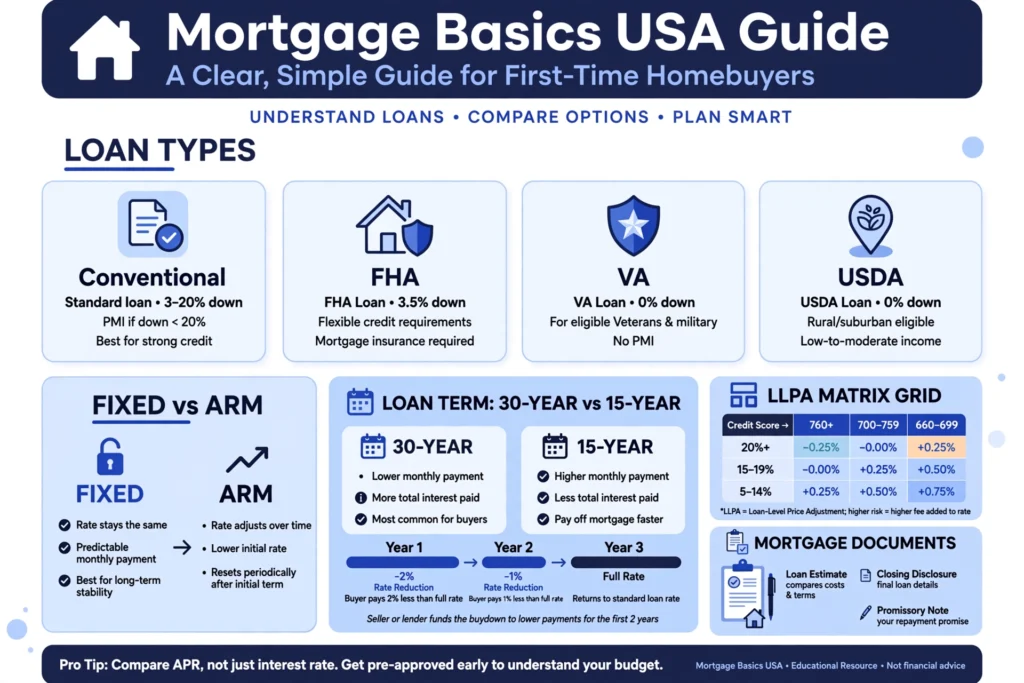
Conventional and government loans differ by down payment, credit, and insurance. Choose based on credit score, down payment, military status, and location.
| Loan Type | Min Down Payment | Credit Score | Mortgage Insurance |
|---|---|---|---|
| Conventional | 3% down | 620 score | PMI 0.3% to 1.5% annually, removable at 80% LTV |
| FHA | 3.5% down | 580 score | MIP 0.85% annually for life if under 10% down |
| VA | 0% down | 580 score no PMI | Funding fee 0.5% to 3.3% one-time, no monthly MI |
| USDA | 0% down | 640 score | Guarantee fee 1% upfront plus 0.35% annual |
Conventional 3% down is HomeReady/Home Possible, 620 minimum per Fannie Mae Eligibility Matrix. FHA 3.5% down with 580 credit per HUD 4000.1 FHA Handbook.
Conventional Loans: Conforming vs Jumbo
Conforming limit is $832,750 in 2026 for one-unit properties in most of US, an increase of $26,250 from 2025. Loans above limit are jumbo requiring 10% to 30% down and 700+ credit. Jumbo rates are 0.25% higher than conforming on average because jumbo loans are not backed by Fannie Mae and Freddie Mac and have higher risk. FHFA sets conforming limits annually based on home price changes. High-cost areas have ceiling $1,249,125 which is 150% of baseline. FHFA Announces 2026 Conforming Loan Limits $832,750 and NAHB: Conforming limit rises to $832,750 in 2026
Government Loans: FHA, VA, USDA Requirements
- FHA: 3.5% down 580 credit MIP for life if under 10% down. MIP is 0.85% annually plus 1.75% upfront. MIP for life if down payment under 10%, otherwise 11 years. Requires primary residence and FHA appraisal.
- VA: 0% down for veterans funding fee 0.5% to 3.3%. Funding fee varies by down payment and first vs subsequent use. Disabled veterans exempt from fee. No monthly PMI, no loan limit for eligible veterans with full entitlement.
- USDA: 0% down rural only income limits. Property must be in USDA eligible rural area, income must be under 115% of area median. Guarantee fee 1% upfront and 0.35% annual. Requires primary residence.
- All require primary residence. Second homes and investment properties are not eligible for FHA, VA, USDA. Must occupy within 60 days of closing.
See FHA loan requirements 2026 for full FHA guidelines.
Fixed-Rate vs Adjustable-Rate Mortgages ARM
| Feature | Fixed-Rate | 5/1 ARM |
|---|---|---|
| Rate Lock Period | Locked for full 15 to 30 years | Fixed 5 years then adjusts annually |
| Initial Rate | 6.5% for 30-year, 5.75% for 15-year in 2026 | 0.5% lower than 30-year fixed, about 6.0% |
| Rate Adjustments | No adjustments, payment never changes | Adjusts every year after 5 years based on SOFR plus margin |
| Best For | Long-term owners who want stable payment | Buyers who will sell or refinance before adjustment |
5/1 ARM fixed 5 years then adjusts annually, initial rate 0.5% lower than 30-year fixed per NerdWallet: ARM initial rate lower. Data: Citizens Bank: 30-year carries slightly higher rate
How ARM Rate Caps Protect Borrowers
ARM rate caps limit how much rate can rise. Initial cap 2% limits first adjustment to 2% increase, periodic cap 2% limits each annual adjustment to 2%, lifetime cap 5% limits total increase to 5% over initial rate. For example, 5/1 ARM at 5.5% can rise to 7.5% year 6 after first 2% cap, 9.5% year 7 after second 2% periodic cap, max 10.5% lifetime with 5% cap. Payment shock risk occurs when rate adjusts from 5.5% to 7.5%, payment on $400k jumps $2,271 to $2,799, $528 increase. Caps prevent unlimited increase but still allow large payment shock. CFPB: ARM caps and payment shock
When to Choose ARM Over Fixed
- You will sell or refinance before adjustment. If you plan to move in 4 years, 5/1 ARM saves 0.5% for 5 years with no adjustment risk.
- You expect income to rise. Higher future income can handle higher payment after adjustment.
- You need lower payment to qualify. Lower initial rate lowers debt-to-income ratio to qualify for larger loan.
Warning: 73% of ARM borrowers do not refinance before reset and face payment shock. Source: CFPB ARM data. Only choose ARM if you can afford payment at lifetime cap.
Loan Term: 30-Year vs 15-Year vs 20-Year
| Term | Payment on $400k at 6.5% | Total Interest |
|---|---|---|
| 30-Year | $2,528/mo | $510,000 interest |
| 20-Year | $2,982/mo | $315,000 interest |
| 15-Year | $3,309/mo | $195,000 interest |
Payments calculated via amortization formula. 30-year total interest $510k is 127% of loan amount. 15-year total interest $195k is 48% of loan. Difference $315k.
How Loan Term Affects Interest Rate
15-year rates are 0.5% to 0.75% lower than 30-year because lender holds less interest rate risk over shorter term. Data: 15-year at 5.75% vs 30-year at 6.5% saves $315,000 interest on $400k loan but payment $781 higher. 30-year payment $2,528 at 6.5%, 15-year payment $3,309 at 5.75%. Shorter term saves interest but requires higher monthly payment, reducing budget flexibility. Ramsey Solutions: 30-year rate 0.5-1% higher than 15-year and NerdWallet Rates Aug 5 2026: 30-year 6.59% APR vs 15-year 6.04% APR
Choosing Term Based on Budget and Goals
- Calculate max payment at 28% of gross income. If gross is $10,000/mo, max housing payment is $2,800 including taxes and insurance.
- Compare payment for each term. On $400k at 6.5%, 30-year $2,528 fits $2,800 budget, 15-year $3,309 does not.
- Choose longest term you qualify for if investing difference, shortest if debt-averse. Investing difference between 15-year and 30-year payment in index fund at 8% returns more than interest savings if you are disciplined investor. If debt-averse, choose 15-year to be mortgage-free faster.
Loan Level Price Adjustments LLPA: Hidden Rate Costs
Loan Level Price Adjustments LLPA are hidden rate costs that Fannie Mae and Freddie Mac add to rate based on credit score, LTV, loan type, occupancy, and property type. Fannie Mae LLPA matrix shows fee as percent of loan amount. For example, 680 credit score with 5% down adds 2.75% to rate or cost. At $400k loan, LLPA equals $11,000 fee if paid upfront, or 0.75% higher rate if built into rate. 780 score with 20% down pays 0% LLPA. LLPAs apply to conventional loans greater than 15-year term. Fannie Mae LLPA Matrix 2026 and Homebuyer.com: LLPA deep dive
LLPA Matrix 2026: Credit Score vs Down Payment
| Credit Score | 5% Down LLPA | 10% Down LLPA | 20% Down LLPA |
|---|---|---|---|
| 780+ | 0.375% | 0.125% | 0.0% |
| 740-779 | 0.875% | 0.5% | 0.0% |
| 700-739 | 1.5% | 1.0% | 0.375% |
| 680-699 | 2.75% | 1.75% | 0.625% |
| 660-679 | 3.75% | 2.5% | 1.125% |
Data based on Fannie Mae LLPA Matrix for purchase loans >15 years. 660 score with 5% down pays 3.75% LLPA vs 0% for 780 score 20% down. At $400k, 3.75% equals $15,000 fee. Source: Fannie Mae LLPA Matrix Page 1 2026 and FitSmallBusiness: LLPA example 778 score 0.625% vs 780 score 0.375%
How to Reduce LLPA Costs
- Improve credit to 740+ saves 1.5%. Going from 680 to 740 with 5% down cuts LLPA from 2.75% to 0.875%, saves $7,500 on $400k.
- Increase down payment to 20% eliminates most LLPA. 20% down brings LLPA to 0% for 780+ and 0.625% for 680, vs 2.75% at 5% down.
- Choose lender-paid LLPA for higher rate. Lender pays LLPA upfront and adds 0.25% to rate. Breakeven if you keep loan under 7 years.
- Wait for credit score increase before applying. Credit improves 20 points per month with on-time payments. Delay application 3 months if close to next tier.
Temporary Buydown: 2-1 and 3-2-1 Explained
Temporary buydown is seller-paid rate reduction for first 1 to 3 years. Define 2-1 buydown: Seller pays to reduce rate 2% year 1, 1% year 2, then full rate year 3. For example, note rate 6.5% becomes 4.5% year 1 and 5.5% year 2. On $500k loan at 6.5%, buydown costs $11,200 and saves buyer $11,200 in payments years 1-2. Calculation: Year 1 payment at 4.5% is $2,533 vs $3,160 at 6.5%, savings $627/mo *12 = $7,524. Year 2 at 5.5% payment $2,838 vs $3,160, savings $322/mo *12 = $3,864. Total savings $11,388. Cost equals savings funded upfront to escrow. Breakeven if buyer keeps loan 2+ years and does not refinance before year 3. The Mortgage Reports: 2-1 buydown costs and savings and Redfin: 2-1 buydown saves $8,868 in first two years
Who Pays for Temporary Buydown
Seller, builder, or lender can fund buydown. Seller concessions limited to 3% to 9% of price depending on loan type. Conventional with 10% down allows 6% seller concessions, FHA allows 6%, VA allows 4% plus reasonable. Buyer cannot pay own buydown per Fannie Mae rules because it would be considered discount points not temporary buydown. Seller-paid buydown must fall within seller concession limits. Builder incentives often include buydown: 64% of builders offered incentives including buydowns in March 2026 per NAHB. US Bank: seller limits 4% to 6% on closing costs
Buydown vs Permanent Rate Discount
| Option | Cost | Benefit |
|---|---|---|
| 2-1 Buydown | $11,200 for 2 years savings | Saves $627/mo year 1, $322/mo year 2, then full rate. Best if rates will drop and you will refinance in 2 years. |
| Permanent Discount Points | $5,000 for 0.25% rate cut all 30 years | Saves $60/mo for 30 years, total $21,600. Breakeven at 7 years. Best if keeping loan long-term. |
Buydown $11,200 for 2 years savings, Points $5,000 for 0.25% rate cut all 30 years. Breakeven at 7 years for points. Data: Mortgage-Info: 2-1 buydown cost $9,096 on $400k at 6.5%
Mortgage Costs: PMI, Closing Costs, Points
- PMI 0.3% to 1.5% annually if under 20% down. On $400k loan with 10% down, PMI $100 to $500 per month. PMI rate based on credit and LTV. 760 score 10% down pays 0.3%, 680 score 5% down pays 1.5%.
- Closing costs 2% to 5% of loan. On $400k loan, closing costs $8,000 to $20,000 includes origination, appraisal, title, recording. CFPB: closing costs explained
- Discount points 1% of loan to cut rate 0.25%. 1 point on $400k costs $4,000 and cuts rate 0.25% from 6.5% to 6.25%, saving $60/mo.
- Origination fee 0.5% to 1%. Lender fee for processing loan, $2,000 to $4,000 on $400k.
- Appraisal $400 to $700. Required by lender to verify home value. Paid upfront, non-refundable.
- Title insurance $1,000 to $2,500. Protects lender and owner from title defects. Owner policy optional but recommended.
How to Remove PMI
- Reach 20% equity based on original value. On $400k purchase, need $80k equity. Pay down $80k or home appreciates to $500k value with $400k balance = 80% LTV.
- Request PMI cancellation in writing. Send written request to servicer with proof of 80% LTV. Servicer cannot require new appraisal if based on original value.
- Lender orders BPO or appraisal. If using current value, lender orders broker price opinion $150 or appraisal $400 to verify 80% LTV.
- PMI drops automatically at 22% equity by law. Homeowners Protection Act requires automatic termination at 78% of original value, 22% equity, if current on payments.
Discount Points: When They Make Sense
1 point costs 1% of loan and cuts rate 0.25%. On $400k loan, 1 point costs $4,000 and saves $60/mo. Breakeven is 67 months. Calculation: $4,000 / $60 = 66.7 months. Buy points only if keeping loan over 6 years. If you sell or refinance before 67 months, you lose money on points. Points are tax-deductible in year paid if you itemize. CFPB: discount points
Frequently Asked Questions
What credit score do I need for a mortgage?
You need 620 for conventional, 580 for FHA with 3.5% down, 500 for FHA with 10% down, and 580 for VA. Higher scores get lower rates and LLPAs. 760+ score gets best rate and lowest PMI. 780+ gets 0% LLPA with 20% down. FHA allows lower scores but requires mortgage insurance for life if under 10% down.
How much down payment do I need?
Minimum down payment is 3% for conventional, 3.5% for FHA, and 0% for VA and USDA. You avoid PMI at 20% down on conventional loans. 20% down on $400k is $80,000. 3% down is $12,000. Down payment affects rate, PMI, and LLPA. Larger down lowers all three costs.
What is the difference between interest rate and APR?
Interest rate is cost to borrow principal. APR includes interest plus fees like points and mortgage insurance expressed as yearly rate. APR is always higher than rate. For example, 6.5% rate with $4,000 points and $2,000 fees has 6.65% APR. APR allows apples-to-apples comparison between lenders. CFPB: difference between rate and APR
Can I get a mortgage with student loan debt?
You can get a mortgage with student loans. Lenders use 0.5% to 1% of balance as monthly payment if on income-driven plan. DTI must stay under 43% to 50% depending on loan type. For example, $50,000 student loans count as $250 to $500 monthly payment. FHA uses 0.5% of balance, conventional uses 1% or actual payment. Keep DTI under 45% for best approval.
What is a mortgage pre-approval?
Pre-approval is lender commitment to loan up to specific amount after reviewing credit, income, and assets. It requires hard credit pull and lasts 60 to 90 days. Pre-approval shows sellers you are serious buyer and how much you can afford. It is stronger than pre-qualification which is estimate. See our mortgage pre-approval checklist for documents needed: W2s, pay stubs, bank statements, tax returns.
How long does mortgage approval take?
Mortgage approval takes 30 to 45 days from application to closing. Pre-approval takes 1 to 3 days. Underwriting takes 2 to 3 weeks after submitting documents. Appraisal takes 1 week, title search 1 week. Delays occur if documents missing or appraisal low. Fast closings possible in 21 days with complete file.
What is escrow on a mortgage?
Escrow is account holding funds for property tax and homeowners insurance. Lender pays bills from escrow. You pay one twelfth of annual cost monthly with mortgage. For example, $6,000 annual tax and $1,200 insurance = $7,200/year = $600/mo escrow added to P+I payment. Escrow analysis annually adjusts payment if taxes change.
Can I pay off my mortgage early?
You can pay off mortgage early with extra principal payments. Most loans have no prepayment penalty. Check mortgage agreement for prepayment privilege limits. Conventional loans after 2014 have no prepayment penalty per Dodd-Frank. FHA and VA never have prepayment penalty. Extra principal saves interest and cuts term. Paying $200 extra monthly on $400k at 6.5% saves $88,000 and cuts 6 years.
Start Your Mortgage Journey
Understand mortgage basics, then calculate your payment with Payoof Mortgage Calculator. Get pre-approved online in 3 minutes. Compare rates from 50+ lenders. Check if you qualify for 3% down. No credit impact to see rates. Start with types, terms, and LLPA costs above, then run your numbers.
Sources: FHFA 2026 Conforming Limit $832,750, NAHB Conforming Limit Rise 3.26%, Fannie Mae LLPA Matrix 2026, Mortgage Reports 2-1 Buydown Cost, Ramsey 30-year 0.5-1% higher than 15-year, NerdWallet Rates Aug 5 2026 30-yr 6.59% vs 15-yr 6.04%, CFPB Mortgage Basics

Disclaimer: This content is for educational purposes only and does not constitute financial, legal, or tax advice — rates, LLPAs, and loan limits vary by lender and location, so verify with your lender and consult a qualified professional before making decisions.