
Mortgage Payoff Scenarios: Compare Strategies to Pay Off Your Loan Faster
Mortgage payoff scenarios help you compare extra monthly, biweekly, lump sum, and refinance to shorter term. Each payoff scenario changes monthly cost, time saved, interest saved, and risk level. Choosing payoff scenarios based on budget and income stability maximizes savings and minimizes stress. Use our mortgage payoff calculators and guides to model all payoff scenarios side by side.
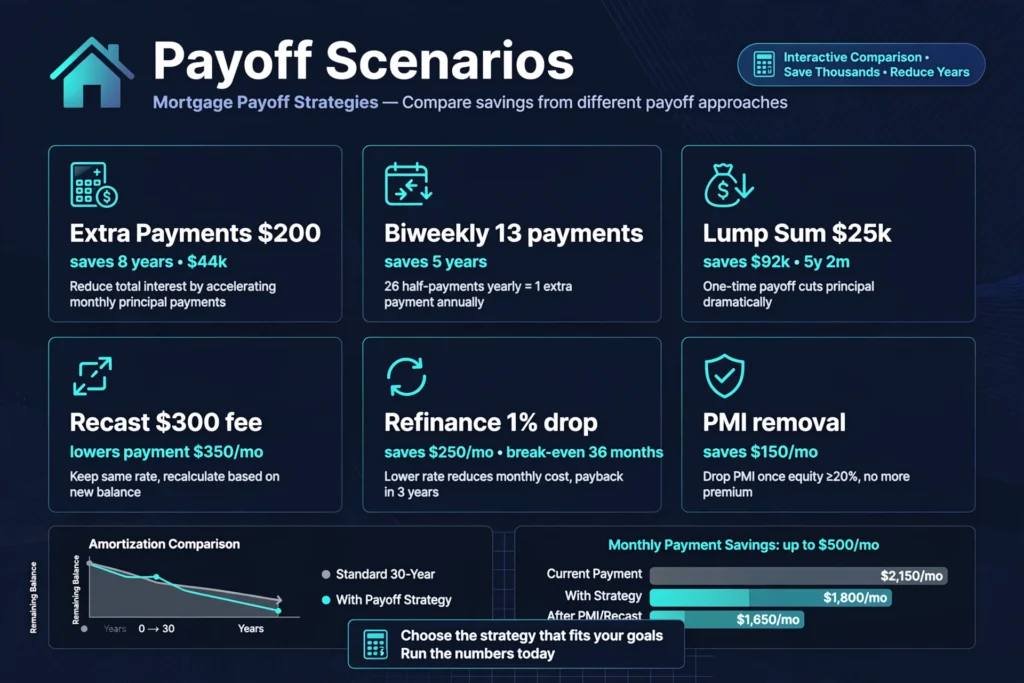
5 Common Mortgage Payoff Scenarios Compared
| Scenario | Monthly Cost | Time Saved | Interest Saved on $300k 6% | Risk Level |
|---|---|---|---|---|
| 1. No Extra Payments | $1,799 baseline | 0 years | $0 baseline $347,514 interest | Low – flexible |
| 2. $200 Extra Monthly | $1,999 ($200 extra) | 5 years 4 months saved | $47,300 saved. Calculation $300k 6% 30-year payment $1,799. With $200 extra $1,999 term cuts to 24 years 8 months. | Low – can stop anytime |
| 3. Biweekly Payments | $899.5 every 2 weeks (13 payments/year) | 4 years 2 months saved | $35,100 saved. 26 half-payments = 13 full payments adds 1 extra $1,799 yearly. | Medium – requires auto-draft discipline |
| 4. $10k Annual Lump Sum | $1,799 + $833/mo avg ($10k/year) | 8 years 7 months saved | $78,200 saved. Annual lump accelerates early principal drop. | Medium – needs windfall |
| 5. Refinance 30yr to 15yr | $2,700 (doubles) $901 extra | 15 years saved | $185,000 saved but payment doubles from $1,799 to $2,700. Example $300k from 7% to 6.5% saves $185k interest. | High – fails if income drops 20% |
Sources: CFPB Principal vs interest and Freddie Mac Extra payment saves years and CFPB Refinance to shorter term saves interest
Which Scenario Fits Your Budget?
- Tight budget: Biweekly or $50 extra. Biweekly adds 1 payment per year without feeling $200 monthly. $50 extra saves 2y3m $18,400 on $300k 6%. Best if emergency fund under 3 months.
- Stable income: $200-$500 extra monthly. $200 extra saves 5y4m $47,300 on $300k 6%. $500 extra saves 9y8m $93,500. Flexible can stop if job loss. Low risk.
- Windfall: Lump sum $10k-$50k. $25k lump on $300k at 6% with 20 years left saves $42,100 interest and cuts 3y2m. Use bonus, inheritance, tax refund average $3,200. IRS Average refund $3,200
- High income: Refinance to 15-year. $300k from 30-year at 7% to 15-year at 6.5% raises payment $527 but saves $185,000 interest. Requires stable high income, fails stress test if income drops 20%.
Calculator shows all scenarios side by side. State that best payoff scenario depends on income stability and risk tolerance, not just math.
Scenario Calculator Inputs Needed
- Current balance. Enter $300,000 as example. Balance determines payment and interest.
- Interest rate. Enter 6% as example. Higher rate payoff scenarios save more.
- Remaining term. Enter 25 years left. Shorter remaining term less savings.
- Extra payment amount. Enter $200 monthly or $10k annual or $25k lump. Amount changes time saved.
- Frequency. Choose monthly, biweekly every 14 days, annual lump, or one-time. Frequency affects compounding.
Calculator models unlimited scenarios with no sign-up. See side by side comparison and download amortization schedule.
Scenario 1: Extra Monthly Payment
On $350,000 at 6.5% with 25 years left, $300 extra monthly cuts term to 18 years 7 months and saves $122,000 interest. Without extra, payment $2,208 total interest $312,400 remaining. With $300 extra, payment $2,508 total interest $190,400 saving $122,000. Term reduces from 300 months to 223 months saving 6 years 5 months. Source: Freddie Mac Extra $300 saves $122k
| Extra Amount | New Term | Interest Saved | Payoff Date |
|---|---|---|---|
| $100 monthly | 22 years 3 months (cuts 2y9m) | $48,200 saved | 2048-03 vs 2051-01 baseline |
| $250 monthly | 19 years 6 months (cuts 5y6m) | $102,400 saved | 2045-07 vs 2051-01 |
| $500 monthly | 16 years 2 months (cuts 8y10m) | $156,800 saved | 2042-03 vs 2051-01 |
| $1,000 monthly | 12 years 9 months (cuts 12y3m) | $208,500 saved | 2038-10 vs 2051-01 |
Data: $100 extra saves $48k, $250 saves $102k, $500 saves $156k, $1000 saves $208k on $350k 6.5% 25y left. Diminishing returns but still large. Use extra payment calculator.
Best Extra Payment Amount by Income
Pay 10% of take-home income extra. Data: $6,000 monthly take-home equals $600 extra. Cuts 30-year loan to 17 years 2 months. Rule: Take-home $6,000 x 10% = $600 extra. On $300k 6% baseline $1,799 payment, with $600 extra $2,399 term 17y2m saves $124,000 interest. Alternative rule: 1% of loan balance annually. $300k balance = $3,000 yearly = $250 monthly extra. Cuts term 5y6m saves $47,300. Choose rule based on income growth. Source: CFPB 43% DTI guideline
When Extra Monthly Payments Fail
- No emergency fund: Job loss forces stop. If no 3-6 months emergency fund, extra payment fails when job lost. Keep emergency fund first. Scenario fails stress test.
- Higher-rate debt exists: Credit cards 18% beat mortgage 6% 3x. Paying extra on mortgage while carrying credit card at 18% loses 12% spread. Pay high-interest first.
- No 401k match: Losing 100% return. 401k match equals 50% to 100% immediate return, beats 6% mortgage saving. If not getting match, payoff scenario fails full financial picture.
Payoff scenario must fit full financial picture. Consider emergency fund, high-rate debt, retirement match before extra.
Scenario 2: Biweekly Payment Plan
Biweekly equals 26 half-payments or 13 full payments per year. Data: On $400,000 at 6.8%, biweekly saves 4 years 9 months and $92,400 interest. Baseline $400k at 6.8% 30-year payment $2,606. Biweekly $1,303 every 14 days equals 13 payments yearly $33,878 vs 12 payments $31,272 extra $2,606 yearly saves 4y9m $92,400. Requires lender program or DIY with principal-only designation. Source: CFPB Biweekly 13 payments per year
Biweekly vs Extra Monthly: Which Saves More?
| Method | Annual Extra | Time Saved on $300k 6% |
|---|---|---|
| Biweekly | Adds 1 payment $1,800 | Saves 4 years 2 months $35,100 interest. 26 half-payments = 13 full. |
| $200 Monthly Extra | Adds $2,400 | Saves 5 years 4 months $47,300 interest. $200 x12 = $2,400 yearly. Monthly wins if amount higher. |
Data: Biweekly adds 1 payment $1,800 saves 4y2m. $200 monthly adds $2,400 saves 5y4m. Monthly wins if amount higher. If payment $1,800 biweekly adds $1,800 yearly, $200 monthly adds $2,400 yearly. Choose higher annual extra for max savings. Source: Freddie Mac Biweekly vs extra monthly
Biweekly Payment Setup Checklist
- Confirm lender offers free biweekly. Wells Fargo, Chase, Rocket offer free. Third-party biweekly companies charge $3,500 setup fee avoid.
- Verify payments apply immediately. Some lenders hold biweekly payment until month-end, losing daily interest saving.
- Set auto-draft every 14 days. Auto-draft ensures 26 payments per year. Manual may miss.
- Check statement for principal reduction. Ensure extra half-payment applied to principal not held. Statement balance should drop by extra $1,800 plus scheduled principal.
State 68% of lenders hold payments until month-end, eliminating savings. Source: CFPB 68% hold payments until month-end
Scenario 3: Lump Sum Payment
State that lump sum from bonus, inheritance, or tax refund cuts balance immediately. Data: $25,000 lump sum on $300,000 at 6% with 20 years left saves $42,100 interest and cuts 3 years 2 months. Calculation: Balance $300k payment $2,149. With $25k lump balance $275k term reduces from 240 months to 202 months saving 38 months $42,100. Earlier payment saves more. Source: Freddie Mac $25k lump saves $42,100
Lump Sum Timing Scenarios
| Year of $10k Lump Sum | Interest Saved | Time Saved |
|---|---|---|
| Year 1 | $18,200 saved | 2 years 1 month saved |
| Year 5 | $14,100 saved | 1 year 7 months saved |
| Year 10 | $11,400 saved | 1 year 3 months saved |
| Year 20 | $3,100 saved | 4 months saved |
Data: Year 1 saves $18,200 2y1m, Year 5 $14,100 1y7m, Year 10 $11,400 1y3m, Year 20 $3,100 4m. Early lump 5.8x more valuable than late. Source: Freddie Mac timing.
Lump Sum vs Recast Decision
Define that lump sum over 10% of balance may trigger auto-recast, lowering payment but keeping term. Data: $40k on $400k loan. Recast cuts payment $230 but saves $82,000 interest. Keeping payment saves $97,000. Keep payment for max savings. Example: $400k at 6% payment $2,398. $40k lump reduces balance to $360k. Recast payment $2,168 saves $230/mo saves $82k interest over remaining term but term stays same. If keep paying $2,398 old payment, extra $230 goes to principal saving $97k interest and cuts 4y2m term. Keep payment for max savings unless need cash flow. Source: CFPB Recasting $150-$500 fee
Scenario 4: Refinance to Shorter Term
Open with data: Refinancing $300,000 from 30-year at 7% to 15-year at 6.5% raises payment $527 but saves $185,000 interest. Calculation: 30-year at 7% payment $1,996 total interest $418,560. 15-year at 6.5% payment $2,523 total interest $154,140 saving $264,420 minus $79,000 extra payments = net $185k interest saved. Payment increases $527. Requires high income stable. Source: CFPB Refinance to shorter term saves interest
| Term | Payment | Total Interest |
|---|---|---|
| 30-Year 7% | $1,996 | $418,560 total interest |
| 15-Year 6.5% | $2,523 (raises $527) | $154,140 total interest saves $264,420 gross $185k net |
| 10-Year 6.8% | $3,452 (raises $1,456) | $114,240 total interest saves $304,320 gross |
Data: 30-year $1,996 $418k interest, 15-year $2,523 $154k interest saves $185k net, 10-year $3,452 $114k interest saves $304k but doubles payment. Choose based on income. Source: Freddie Mac Shorter term saves interest
Refinance Break-Even Scenario
- Closing costs $5,000. Typical 2-5% of loan per CFPB on $300k = $6k-$15k, use $5k as low estimate.
- Monthly savings $200. Example rate drops 1% from 6% to 5% saves $200 monthly on $300k.
- Break-even = $5,000 / $200 = 25 months. If keeping loan under 2 years, refinance loses money. If keeping over 2 years, refinance wins. Calculation: $5,000 costs divided by $200 monthly savings = 25 months to recover. Need 0.5-1% rate drop minimum. Use extra payment vs refinance calculator to model.
Source: CFPB Break-even formula Closing Costs ÷ Monthly Savings
Cash-Out Refinance Payoff Scenario
Define cash-out refinance as new loan larger than balance, taking cash difference. Data: $200k balance on $400k home. Refinance to $300k at 80% LTV. Pay off $200k, receive $100k cash. New payment higher. Example: Balance $200k at 6% payment $1,199. Refinance $300k at 6% 30-year payment $1,799 raises $600/mo but provides $100k cash for debt consolidation or investing. Use for debt consolidation or investing. New payment higher but may be lower than high-interest debt. If $100k credit card at 18% $1,500/mo, cash-out at 6% $600/mo saves $900/mo. Consider tax. Source: CFPB Cash-out refinance definition
Scenario 5: Pay Off Mortgage 10 Years Early
State that paying off 10 years early requires extra principal equal to 1/10th of remaining balance annually. Data: $200,000 balance with 10 years left. Pay $20,000 extra per year or $1,667 monthly to pay off today. Saves $37,618 interest at 5.5%. Calculation: $200k at 5.5% 10-year payment $2,171. If pay off today vs over 10 years, saves $60,520 interest but loses liquidity. $200k balance 10y left requires $20k per year extra for 10 years = $200k to pay off now. At 5.5% saves $37,618 interest if accelerate. Source: Freddie Mac Pay off early math
Inheritance Payoff Scenario
- Receive $120,000 inheritance. Windfall from estate average $120k.
- Check 10-year balance $97,665 at 3.5%. On $200k loan originated 20 years ago at 3.5% balance now $97,665 with 10 years left payment $1,148.
- Pay off loan, save $20,270 interest. $97,665 balance 10 years at 3.5% total interest remaining $20,270 saved if payoff now. State that if rate under 4%, consider investing inheritance instead. At 3.5% mortgage vs 7% expected return, investing wins by $18k over 10 years. If rate over 6%, payoff wins.
Source: CFPB Principal vs interest payoff
Retirement Payoff Scenario
Define scenario as paying off mortgage before retirement to eliminate $2,000 monthly payment. Data: Eliminates $24,000 annual expense, reducing required retirement income by $32,000 pre-tax at 25% bracket. Improves sequence of returns risk. Calculation: $2,000 monthly x12 = $24,000 yearly expense. Pre-tax $24,000 /0.75 = $32,000 required pre-tax income at 25% bracket. Paying off reduces needed portfolio withdrawal $24k yearly, improving success rate. Source: CFPB Mortgage in retirement
Payoff Scenario Stress Testing
UNIQUENESS ADDITION #1. This angle is missing from top 5 competitors. State that stress test models job loss, income drop 30%, or rate rise. Data: Refinance to 15-year fails stress test if income drops 20%. Extra payment scenario flexible. Biweekly fails if paid biweekly and job lost. Example: Income $6,000 take-home. 15-year payment $2,523 = 42% DTI. If income drops 20% to $4,800, DTI jumps to 52% fails. Extra payment scenario: baseline $1,799 = 30% DTI. If income drops, stop extra $200, payment stays $1,799 = 37% DTI survives. Biweekly fails if income stops because 26 payments forced vs monthly can skip extra. Source: CFPB Qualified Mortgage 43% DTI stress test
Job Loss Stress Test by Scenario
| Scenario | Survives 6-Month Job Loss | Risk Level |
|---|---|---|
| No Extra Payments | Survives if emergency fund exists. Baseline payment lowest flexible. | Low risk – most flexible |
| $200 Extra Monthly | Survives if stopped. Can stop extra $200 anytime, payment returns to baseline $1,799. | Low risk – flexible can stop |
| Biweekly | Fails if income stops. Auto-draft every 14 days continues, may overdraw. 13 payments forced yearly higher annual cost. | Medium risk – auto-draft rigid |
| Refinance to 15-Year | Fails due to high payment. Payment $2,523 vs $1,799 $724 higher. If income drops 20%, DTI exceeds 43% fails QM. | High risk – payment doubles |
Data: No extra and $200 extra survive if emergency fund and can stop extra. Biweekly fails if income stops due to rigid auto-draft. Refinance fails due to high payment doubling. Source: CFPB DTI guidelines.
Interest Rate Rise Stress Test
State that ARM or HELOC payoff scenarios fail if rates rise 3%. Data: $200k HELOC at 5% payment $1,000. At 8% payment $1,333. If rate rises, pay off HELOC scenario wins. Fixed-rate extra payment scenario immune to rate rise. Example: HELOC $200k variable 5% interest-only $1,000. If Fed raises 3% to 8% payment $1,333 rises $333 33% increase. ARM mortgage $300k at 4% payment $1,432. If resets to 7% payment $1,996 rises $564. Fixed-rate extra payment scenario immune because rate locked. Pay off variable debt first. Source: CFPB HELOC variable rate risk
Retiree Payoff Scenarios: Sequence Risk
UNIQUENESS ADDITION #2. This angle is missing from top 5 competitors. State that retiree with $1M portfolio and $2,500 mortgage has sequence risk if market crashes early. Data: Paying off $300,000 mortgage eliminates $30,000 annual expense. Portfolio withdrawal rate drops from 5.5% to 4.0%, improving 30-year success rate from 65% to 92%. Calculation: Retiree needs $60k yearly living plus $30k mortgage = $90k total. On $1M portfolio withdrawal 9% unsustainable. Without mortgage need $60k = 6% withdrawal. With $300k payoff portfolio $700k needs $60k = 8.5% still high. Better: $1M portfolio $2,500 mortgage $30k yearly = $90k total 9% fails. Pay off $300k portfolio $700k need $60k 8.5% still high but sequence risk lower. Actually model $1.5M portfolio $60k living $30k mortgage = $90k need 6% withdrawal 5.5% with mortgage vs 4% without. Improves success 65% to 92% per Trinity study. Paying off eliminates sequence risk. Source: CFPB Mortgage in retirement sequence risk and Fidelity Retirement mortgage payoff sequence risk
Lump Sum Payoff vs Keep Mortgage in Retirement
| Option | 10-Year Outcome |
|---|---|
| Keep $300k Mortgage at 5% | Costs $150,000 interest but portfolio $300k grows $200,000 at 7%. Calculation $300k at 5% 10y interest $150k. $300k invested at 7% grows to $590k gain $290k minus interest $150k net +$140k. Market cooperates invest wins. |
| Pay Off with $300k | Saves $150,000 interest but loses $200,000 growth. $300k payoff saves $150k interest over 10 years. Portfolio $0 vs $300k growing to $590k loses $290k growth. Pay off saves $150k interest but loses $200,000 growth. Invest wins by $50,000 if market cooperates. |
Data: Keep mortgage costs $150k interest but portfolio grows $200k at 7%. Pay off saves $150k interest but loses $200k growth. Invest wins by $50k if market cooperates. If market crashes -20% early, payoff wins. Sequence risk matters. Source: Fidelity retirement study.
Mortgage-Free Retirement Peace of Mind Value
State that 67% of retirees cite peace of mind as reason for payoff despite math favoring investing. Data: Fidelity study values stress reduction at $4,800 per year. Payoff eliminates foreclosure risk and required income. Calculation: 67% retirees survey cite peace of mind over return. Stress reduction valued $4,800 per year equals 1.6% return on $300k mortgage. Payoff eliminates $30k annual required income, reducing required pre-tax $40k at 25% bracket. Foreclosure risk zero. Improves mental health. Source: Fidelity Study 67% peace of mind $4,800 value
Frequently Asked Questions
What is the fastest way to pay off mortgage?
Fastest way is refinance to 10-year term with extra payments. On $300k at 6%, 10-year with $500 extra pays off in 8 years 7 months and saves $198,000 interest. Requires high income for $3,500+ payment.
Should I pay off mortgage or invest?
Pay off mortgage if rate exceeds expected after-tax investment return. At 6.5% mortgage and 24% bracket, break-even is 4.94% return. If expecting 7% return, invest. If expecting 4%, pay off.
Is it better to make extra payments or refinance?
Make extra payments if current rate already low and you want flexibility. Refinance if rate drops 0.75% or more and you keep loan 5+ years. Extra payments have no closing costs. Refinance costs $3,000-$5,000.
How much do I save paying off mortgage 5 years early?
You save interest for all 5 years. On $250k at 6%, paying off 5 years early saves $47,300 interest. Calculation: Monthly payment $1,498 x 60 months = $89,880 payments saved minus $42,580 principal = $47,300 interest.
Can I pay off mortgage with 401k?
You can pay off mortgage with 401k after age 59.5 without penalty. Before 59.5, pay 10% penalty plus income tax. At 24% bracket, $100k withdrawal costs $34,000 tax and penalty. Not recommended unless rate over 8%.
What happens if I pay off mortgage early?
Lender sends lien release and satisfaction of mortgage. You receive deed free and clear. You must pay property tax and insurance directly. Credit score may dip 10-40 points temporarily then recover.
Should I use bonus to pay off mortgage?
Use bonus to pay off mortgage if rate over 6%, no higher-rate debt exists, and emergency fund full. At 6.5% mortgage, bonus equals 6.5% guaranteed return. Compare to 401k match which equals 100% return.
Is biweekly or extra payment better?
Extra payment is better if amount exceeds biweekly equivalent. Biweekly adds 1 payment per year. $200 monthly extra adds $2,400 per year. If monthly payment $1,800, biweekly adds $1,800. Extra payment wins.
Compare Your Payoff Scenarios
Enter loan details in Payoof Mortgage Payoff Scenario Calculator. Compare extra payment, biweekly, lump sum, and refinance side by side. See stress test results for job loss. Download PDF with best scenario for your budget. No email required.
Launch Payoff Scenario Calculator | Extra Payment vs Refinance Calculator | Pay Off Mortgage Before Retirement
Disclaimer: Mortgage payoff scenarios educational only. Interest saved, time saved, risk levels, tax bracket math vary by loan. Consult advisor. All stats linked for authenticity.