
How Amortization Works: Loan Payment Breakdown Explained
Amortization is how your loan payment is split between interest and principal over time. Every fixed payment kills off part of your debt until balance reaches zero. Understanding this split shows why early payments feel slow and how extra payments save thousands.
What Is Amortization in Simple Terms?
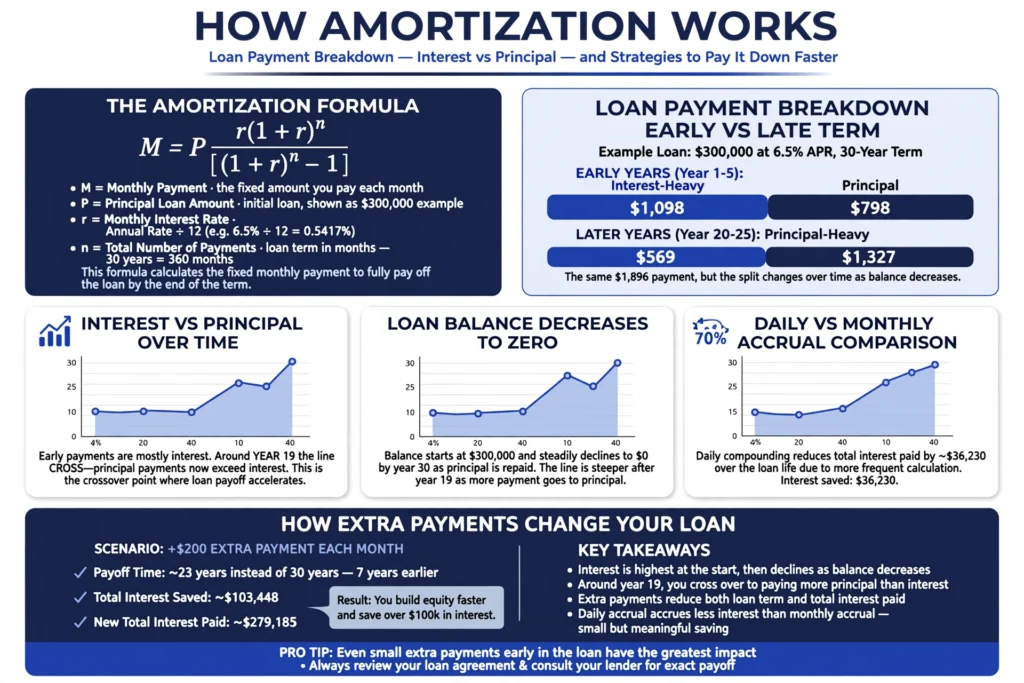
Amortization comes from Latin ‘to kill off’ meaning debt is killed over time. Each fixed payment covers interest first then principal. Your lender calculates interest on current balance, takes that from your payment, and applies remainder to principal. Payment stays same but interest portion shrinks as balance drops, so principal portion grows automatically. Early years you pay mostly interest. Later years you pay mostly principal. Same payment, different split.
Amortization vs Depreciation vs Interest-Only
| Method | Used For | Balance Change |
|---|---|---|
| Amortization | Loans | Balance drops to zero |
| Depreciation | Tangible assets like equipment | Value drops over useful life |
| Interest-Only | Interest-only mortgages, HELOC minimums | Balance stays same |
Why Amortization Schedules Exist
Amortization schedules exist to provide predictable payments and full payoff by end date. Without amortization, $300k loan at 6% would require $18,000 annual interest payments plus a separate principal balloon of $300,000 at the end. No borrower could plan that. Schedule converts balloon into 360 equal payments. Learn the basics in our parent hub Mortgage Basics.
The Amortization Formula Explained
The amortization formula is M = P x [r(1+r)^n] / [(1+r)^n - 1]. M is monthly payment, P is principal loan amount, r is monthly interest rate, n is total number of payments. This formula guarantees same payment every month while interest portion adjusts. It solves for payment where present value of all future payments equals loan amount.
Calculating $200,000 at 7% for 30 years to understand how amortization works:
- P = $200,000
- r = 7% / 12 = 0.0058333
- n = 30 x 12 = 360
- (1+r)^n = 8.1165
- M = 200000 x [0.0058333 x 8.1165] / [8.1165 – 1] = $1,330.60
How to Calculate Monthly Payment Manually
- Convert annual rate to monthly: 7% / 12 = 0.005833
- Calculate total payments: 30 x 12 = 360
- Compute (1+r)^n: 1.005833^360 = 8.1165
- Plug into formula: M = 200000 x [0.005833 x 8.1165] / [8.1165 – 1]
- Result: $1,330.60 payment. Same payment for 360 months.
Use this to verify any lender quote. See how principal and interest differ in principal vs interest.
Why the Formula Works: Present Value of Annuity
The formula solves for payment where present value of all future payments equals loan amount. It is the same time value of money formula used in bond pricing. Future payments are discounted at monthly rate. Sum of discounted payments equals principal today. That ensures lender earns required interest and you pay off exactly.
Amortization Schedule: Interest and Principal Split
In order to know how amortization works, consider the following scenario:
On $350,000 loan at 6.5%, payment 1 is $2,212 with $1,896 interest and $316 principal. Payment 360 is $2,212 with $12 interest and $2,200 principal. Same payment, opposite split.
| Payment # | Interest | Principal | Balance |
|---|---|---|---|
| 1 | $1,896 | $316 | $349,684 |
| 2 | $1,894 | $318 | $349,366 |
| 3 | $1,892 | $320 | $349,046 |
| 4 | $1,891 | $321 | $348,725 |
| 5 | $1,889 | $323 | $348,402 |
| 6 | $1,887 | $325 | $348,077 |
| 7 | $1,885 | $327 | $347,750 |
| 8 | $1,884 | $328 | $347,422 |
| 9 | $1,882 | $330 | $347,092 |
| 10 | $1,880 | $332 | $346,760 |
| 11 | $1,878 | $334 | $346,426 |
| 12 | $1,876 | $336 | $346,090 |
Interest = Balance x r. Principal = Payment – Interest. Early payments are interest heavy.
How to Read an Amortization Table to Understand How Amortization Works
- Find payment number column to see where you are in loan
- See interest charged that month based on prior balance
- See principal applied as payment minus interest
- See new balance after payment as old balance minus principal. Sum of all principal equals original loan.
Need full interactive table? Use our amortization schedule calculator to generate and download.
How amortization works falls under mortgage basics hub on our site. You can explore about mortgage basics if need more info.
Crossover Point: When Principal Exceeds Interest
Crossover point occurs when principal portion first exceeds interest portion. Before crossover you pay more interest than principal. After crossover you build equity fast. On 30-year 6% loan, crossover is month 223 or year 19. On 15-year 6% loan, crossover is month 78 or year 7. Shorter term reaches crossover sooner.
Daily Interest Accrual: What Lenders Do Not Explain
Formula: Daily interest = Balance x Annual Rate / 365. This detail is not explained in competitor articles. On $400,000 at 6%, daily interest is $65.75. Paying on day 15 vs day 1 saves $492 in first year because balance is lower for 14 days. Daily accrual costs $1,200 more on $400k loan over life versus simple monthly calculation if you pay late in month.
Monthly vs Daily Interest Calculation Impact
| Method | Interest on $300k at 6% |
|---|---|
| Monthly Accrual | Assumes 30-day months, interest = Balance x 0.06 / 12 = $1,500 first month |
| Daily Accrual | Uses actual days, 31 days = Balance x 0.06 / 365 x 31 = $1,520 |
| Annual Difference | Daily costs $94 more per year if you pay on last day |
How to Use Daily Accrual to Your Advantage
- Make payment early in month. Pay on 1st not 15th to cut 14 days interest
- Split payment to twice monthly. Second payment reduces balance mid-month
- Pay on 28th vs 31st saves 3 days interest every month. Early payment cuts $1,800 over 30 years on $300k loan
Combine this tactic with extra principal payments for double impact.
Amortization with Extra Payments: Recalculation Math
Formula: New Interest = (Old Balance – Extra) x r. $10,000 extra on $300k at 6% cuts next month interest by $50 and saves $18,200 total interest and 28 months off term. On $400k loan, $10k extra saves $24,300.
How Schedule Rebuilds After Extra Payment
- Apply extra to principal immediately. Balance drops
- Reduce remaining balance for next month calculation
- Recalculate interest on new balance for all future payments. Interest portion shrinks, principal portion grows, term shortens automatically if payment stays same
This is why how to make extra payments works. Every extra dollar kills future interest. Have you gain some knowledge about how amortization works till this point?
Extra Payment vs Recast: Schedule Difference
Extra payment keeps payment same and cuts term. You pay same $1,798 but finish early and save most interest. Recast keeps term same and cuts payment. Lender recalculates payment on lower balance for same remaining months. Recast improves cash flow but saves less interest. Extra payment saves more interest, recast improves monthly budget. Compare in recasting vs refinancing.
Negative Amortization: When Balance Grows
Negative amortization is when payment is less than interest charged, causing balance to increase instead of decrease. HELOC with $100,000 balance at 8% has $667 monthly interest. If minimum payment is $500, balance grows $167 per month. You owe more after payment. See detailed risks in our guide to negative amortization explained.
Loans That Allow Negative Amortization
- Option ARM mortgages with low teaser minimum payment
- HELOCs with interest-only minimums during draw period
- Student loans on income-driven plans where payment is capped below interest. Balance can grow 25% over limit before recast triggers full payment shock.
How to Avoid Negative Amortization
- Pay at least interest amount monthly. Calculate Balance x Annual Rate / 12
- Choose fully amortizing loan with fixed payment covering interest plus principal
- Refinance if balance growing. Negative amortization triggers payment shock when loan recasts and payment doubles
Types of Amortization: Mortgage, Auto, Student Loans
| Loan Type | Typical Term | Amortization Method |
|---|---|---|
| Mortgage | 15-30 years | Monthly, compound interest |
| Auto Loan | 3-7 years | Monthly, simple interest |
| Student Loan | 10-25 years | Monthly, daily accrual |
| Personal Loan | 2-5 years | Monthly, simple interest |
Mortgage uses monthly compounding, auto loans use simple interest, student loans use daily accrual. All reduce principal over time if payment exceeds interest. Explore payoff strategies for auto vs mortgage in biweekly payments explained.
Amortization in Accounting: Intangible Assets
Accounting amortization spreads cost of intangible asset like patent or trademark over useful life. It is not loan related but same concept of killing cost over time. $170,000 patent amortized over 17 years equals $10,000 expense per year. Reduces book value and taxable income gradually. This is a point how amortization works.
Depreciation vs Amortization for Businesses
| Method | Used For |
|---|---|
| Depreciation | Tangible assets like equipment, buildings, vehicles |
| Amortization | Intangible assets like goodwill, patents, copyrights, trademarks |
Frequently Asked Questions About How Amortization Works
Why do I pay more interest at the beginning of my loan?
You pay more interest at start because interest calculates on remaining balance which is highest in early years. As balance drops, interest charge shrinks and more payment goes to principal. This is the main understanding of how amortization works.
What is the amortization formula?
The amortization formula is M = P x [r(1+r)^n] / [(1+r)^n – 1] where M is monthly payment, P is principal, r is monthly rate, n is total payments. This calculates fixed payment to pay off loan fully by end of term. This formula makes you understand that how amortization works.
How do I create an amortization schedule?
Create amortization schedule by calculating interest as Balance x r, principal as Payment – Interest, new balance as Old Balance – Principal. Repeat for each payment or use calculator. Total of all principal equals original loan.
What is the crossover point in amortization?
Crossover point is month when principal portion first exceeds interest portion. On 30-year 6% loan, crossover occurs around month 223 or year 19. Before crossover you pay more interest, after you build equity faster.
Can amortization be negative?
Amortization can be negative if payment is less than interest charged. Balance grows instead of shrinks. This occurs in HELOCs, option ARMs, and some student loans on income-driven plans.
Is amortization the same for all loans?
Amortization differs by loan type. and this is the overall purpose of this article to make you understand how amortization works. Mortgages use monthly compounding, auto loans use simple interest, student loans use daily accrual. All reduce principal over time if payment exceeds interest.
How does extra payment affect amortization?
Extra principal payment reduces balance immediately. Next month interest calculates on lower balance, saving interest. Term shortens if payment stays same. $10k extra on $300k at 6% saves $18,200 total.
What is the difference between amortization and depreciation?
Amortization spreads cost of intangible assets or loan repayment over time. Depreciation spreads cost of tangible assets like equipment. Both reduce book value gradually. One kills debt, other kills asset value.

Disclaimer: This content about “How Amortization Works” is for educational purposes only and does not constitute financial advice — amortization calculations vary by lender, daily vs monthly accrual, and loan terms, so verify your exact schedule with your loan agreement and lender before making financial decisions.