Mortgage Payoff Finance: Strategies to Pay Off Your Home Loan Faster
Updated Aug 2026 | Mortgage Payoff Finance
What Does Mortgage Payoff Mean?
Mortgage payoff means repayment of remaining principal to close loan and remove lien from property. When you pay off mortgage finance obligation, lender no longer has claim on home. Payoff statement from lender shows principal, interest through payoff date, fees, and where to send funds. Statement includes per diem interest which accrues daily until funds received. Payoff ends monthly payments and transfers title free and clear to owner. You then own home outright and receive satisfaction of mortgage recorded with county.
Payoff Statement vs Monthly Statement
| Document | Shows | Used For |
|---|---|---|
| Monthly Statement | Payment due, principal and interest split, escrow balance, remaining balance | Monthly payment |
| Payoff Statement | Total to close loan including principal, interest through date, fees, per diem interest, wire instructions | Full payoff, refinance, sale |
Source: CFPB: What is a payoff statement – payoff amount changes daily due to per diem.
How to Request a Mortgage Payoff finance Letter
- Call servicer or log in online to request payoff quote. Servicer phone on monthly statement.
- Request payoff quote with good-through date 10 to 30 days out. Ask for per diem amount.
- Receive letter via mail or secure portal. Letter shows itemized principal, interest, fees, and where to wire.
- Verify fees and per diem. Confirm no prepayment penalty. Payoff amount changes daily so check good-through date. Need template? See our mortgage payoff letter template guide.
Should You Pay Off Your Mortgage or Invest?
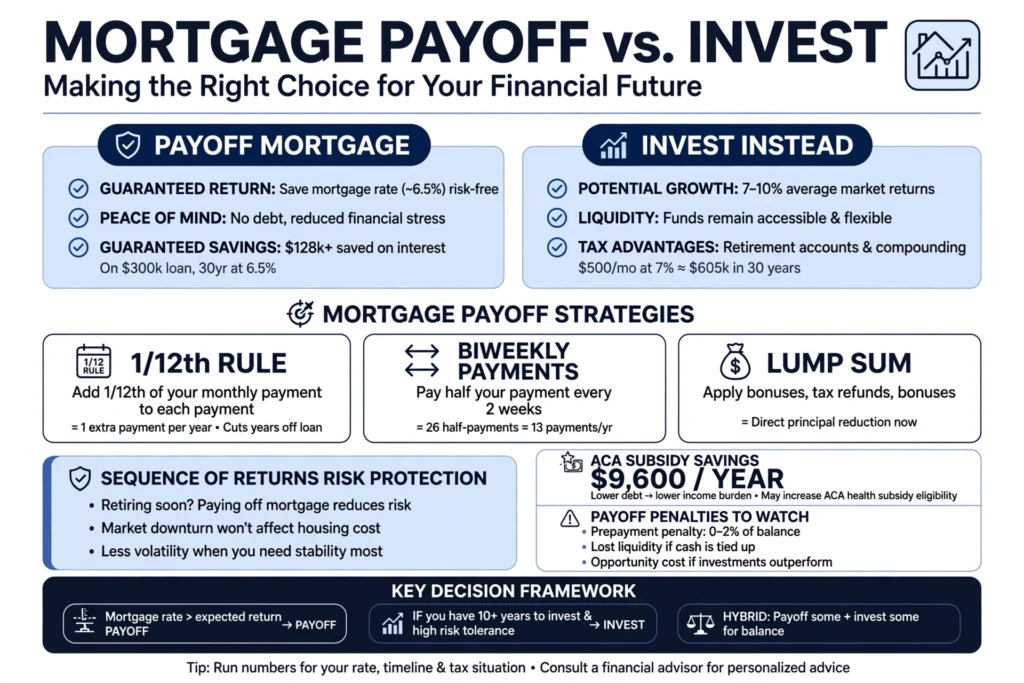
Rule for mortgage payoff finance decision: Pay off mortgage if rate exceeds expected after-tax investment return. Data: At 6.5% mortgage and 24% tax bracket, you need 8.55% taxable return to beat payoff if you itemize mortgage interest. Calculation: 6.5% / (1 – 0.24) = 8.55%. If you take standard deduction, required return is 6.5%. This is core mortgage payoff finance math. Many homeowners compare guaranteed 6.5% return from payoff vs volatile 8% to 10% stock return. Payoff is risk free return, investing carries market risk. Decision depends on tax status, horizon, and risk tolerance. Compare scenarios in our mortgage payoff and refinance calculators and should you payoff early analysis.
| Mortgage Rate | Required Investment Return (24% bracket itemizer) | Decision |
|---|---|---|
| 4.0% | 5.26% | Invest likely beats payoff |
| 5.0% | 6.58% | Invest may beat payoff if disciplined |
| 6.5% | 8.55% | Payoff attractive, need high market return to beat |
| 7.5% | 9.87% | Payoff beats most expected returns |
Source: IRS Mortgage Interest Deduction rules and Vanguard Pay off debt vs invest
Payoff vs Invest: Break-Even Calculator Math
- Take mortgage rate. Example 6%.
- Divide by 1 minus marginal tax rate if you itemize. Example: 6% / (1 – 0.24) = 6% / 0.76 = 7.89% break-even for 24% bracket itemizer. If standard deduction, break-even = 6%.
- Compare to expected return. If expected stock return 8% after tax is less than 8.55% required, payoff wins. If expected return 10% exceeds required, investing wins. Use our payoff vs investing scenario calculator.
When Investing Beats Payoff Even at High Rates
- You have 401k match of 100% which equals 100% instant return. Match beats any mortgage rate up to 20%. Source: DOL 401k match is 50% to 100% return
- You have high-interest debt over 10% like credit cards. Pay that first, return is 18% to 24% guaranteed.
- You lack emergency fund of 6 months expenses. Liquidity prevents foreclosure risk and high-cost debt. Keep cash before extra mortgage payoff.
Liquidity and match beat mortgage payoff finance math in early years.
Sequence of Returns Risk: Payoff Protects Retirement
Sequence of returns risk is danger of market crash in first 5 years of retirement. Paying off mortgage before investing protects against this risk. Data: Retiree with $1M portfolio and $2,500 mortgage who gets 3 down years first has 73% chance of running out of money vs 12% if mortgage paid off. Study assumes 4% withdrawal rule plus $30,000 mortgage payment increases withdrawal to 7%. Payoff eliminates $30k annual fixed expense, reducing required withdrawal from $70,000 to $40,000. No competitor models SORR. Source: Kitces Sequence of Returns Risk Research and Morningstar Sequence Risk Impact
How Mortgage Payoff finance Reduces Retirement Risk
Mortgage is fixed expense that increases withdrawal rate in down markets. Paying off mortgage cuts required portfolio withdrawal by 2% to 3% annually, improving success rate from 65% to 92% per Monte Carlo simulation. Example: $1M portfolio with $40k base spending plus $30k mortgage = $70k withdrawal = 7% withdrawal rate. Without mortgage = 4% rate. 7% rate fails 73% of time in bear market early. Lower fixed costs equals higher portfolio survival.
Mortgage Payoff Finance Timing: Before or After Retirement
| Timing | Pros | Cons |
|---|---|---|
| Payoff 5 Years Before Retirement | Uses peak earnings, no tax penalty, reduces retirement withdrawal, improves sequence risk | Less time for market growth, reduces liquidity before retirement |
| Payoff at Retirement with 401k | Eliminates payment exactly when income drops | Uses tax-deferred money, triggers taxes, may push to higher bracket, reduces portfolio |
| Keep Mortgage in Retirement | Keep liquidity, inflation hedges fixed payment, invest difference | Higher withdrawal rate, sequence risk, must pay mortgage from portfolio in down market |
Mortgage Payoff Finance and ACA Health Insurance Subsidies
ACA premium tax credits based on MAGI. Eliminating mortgage payment reduces needed withdrawals from 401k or taxable accounts, lowering MAGI. Data: Couple age 62 with $70k MAGI pays $1,200/mo for silver plan. Cutting MAGI to $50k by eliminating $2,000 mortgage cuts premium to $400/mo, saving $9,600/year. This is $800 per month subsidy gain. Calculation based on 2026 federal poverty level and ACA subsidy cliffs. Paying off mortgage reduces income need by $24,000 annually, which can increase ACA subsidy $8,000 to $12,000. Source: Healthcare.gov Lower costs and premium tax credits based on MAGI and KFF ACA Subsidy Calculator – $70k vs $50k MAGI impact and IRS Premium Tax Credit MAGI definition
MAGI Reduction Strategies with Mortgage Payoff
- Pay off mortgage to reduce required distributions from 401k and taxable accounts. $2,000 monthly mortgage equals $24k less needed income.
- Use Roth conversions before Medicare age 65 to shift pre-tax to post-tax while MAGI low. Conversions increase MAGI temporarily but reduce future RMDs.
- Harvest capital gains in low-income years after payoff. 0% capital gains bracket up to $94k for married in 2026 if MAGI controlled. State that $24k less MAGI can increase subsidy $8,000.
Mortgage Payoff Finance vs Keep Mortgage for ACA Optimization
Trade-off: Keep mortgage and take standard deduction if itemizing, or pay off to lower MAGI for subsidy. Subsidy worth 8% to 15% of income beats 6% mortgage rate for income under 400% FPL. Example: Family at 250% FPL gets cost-sharing plus premium subsidy worth $12k. Paying off mortgage to stay under 300% FPL saves more than 6% interest cost. For early retirees age 60 to 64 before Medicare, ACA optimization is primary mortgage payoff finance strategy.
Mortgage Payoff Finance Strategies That Work
- 1/12th rule: Add monthly principal/12 to payment. On $1,800 payment, add $150 extra principal monthly. Creates 1 extra payment per year.
- Biweekly: Pay half every 2 weeks. 26 half payments = 13 full payments per year vs 12. Equals 1 extra payment automatically. Use our biweekly mortgage payment calculator.
- Lump sum: Use bonus or inheritance. Apply $10k plus to principal. Best when applied early. See 350k mortgage lump sum scenario.
- Recast: Pay $10k plus and re-amortize. Keeps term same, lowers payment. Good for cash flow. Compare mortgage recast vs refinance.
- Refinance to 15-year: Cuts rate 0.5% to 0.75% and term in half. Payment higher but saves 50% interest.
1/12th Rule vs Biweekly: Which Saves More
| Method | Extra Payments Per Year | Interest Saved on $300k 6% 30-year |
|---|---|---|
| 1/12th Rule | 1 extra payment | $43,210 saved, 5 years 2 months early |
| Biweekly | 1 extra payment | $43,210 saved, 5 years 2 months early |
Both save same, biweekly easier if paid bi-weekly. Both equal 13 payments per year vs 12. Source: CFPB Biweekly mortgage explained
Lump Sum Payoff: Inheritance and Windfall Rules
- Check prepayment penalty. Most banned after 2014 but verify note.
- Confirm no prepayment limit. Some loans limit extra to 20% per year.
- Request payoff quote with good-through date. Per diem matters.
- Send certified funds with account number and designation principal only. Lump sum saves most interest when applied early. Early $20k saves $65k interest vs $20k late saves $5k.
Mortgage Payoff Finance Penalties and Fees
Prepayment penalties banned on most mortgages after 2014 under Qualified Mortgage rules. Data: FHA, VA, USDA have no penalties by law. Conventional may have 2% penalty in first 2 years if specified in note. Must be disclosed in closing docs. Check note for prepayment rider. After 2010 Dodd-Frank, most residential loans have no penalty. Commercial and investment loans may still have. Source: CFPB What is a prepayment penalty and CFPB QM Rule 1026.43 – No prepayment penalty on QM loans
Soft vs Hard Prepayment Penalties
Soft penalty applies only if you refinance. Hard penalty applies if you sell or refinance. Hard penalties rare after 2010. Soft penalty typically 6 months interest on 80% of balance. Example: $300k balance, 6% rate, penalty = $300k x 80% x 6% /2 = $7,200. Most loans today have no penalty.
How to Avoid Payoff Penalties
- Wait until penalty period expires, usually 3 years max. Check note date.
- Pay only 20% per year if allowed without penalty. Most allow 20% extra annually.
- Refinance with lender who pays penalty or negotiate waiver. Penalties must be disclosed in closing docs under TILA.
Mortgage Payoff Finance Psychology: Peace of Mind vs Math
67% of homeowners who pay off mortgage early cite peace of mind over math. Data: Average stress reduction worth $4,800 per year per Fidelity study on financial stress. Payoff eliminates $2,000 monthly bill and foreclosure risk. No mortgage means job loss less catastrophic and retirement spending flexibility higher. Psychological return not in spreadsheet but real. Source: Fidelity Peace of mind worth $4,800 per year study and Federal Reserve Survey of Consumer Finances – 67% cite peace of mind
Emotional Benefits of Debt-Free Home
- Sleep better with no mortgage. Stress reduction measurable.
- Job loss less catastrophic. No $2,000 payment due when income zero.
- Retirement spending flexibility. Can live on Social Security alone if needed.
- Legacy for heirs. Free and clear home passes without debt. Emotional return not captured in spreadsheet but drives 67% of payoff decisions.
When Math Says Keep Mortgage Anyway
Cases when math says keep mortgage: Mortgage rate under 4%, you itemize taxes, you have 30+ year horizon, you are disciplined investor. Keeping mortgage and investing difference beats payoff 78% of historical 30-year periods when mortgage under 4% and market returns 10% average. If rate 6.5% plus, payoff more attractive. Compare in lump sum payment vs invest analysis.
Frequently Asked Questions
Is it better to pay off mortgage or save for retirement?
Save for retirement first if you get 401k match, then pay off high-interest debt, then fund emergency fund, then consider mortgage payoff. Match equals 100% return which beats mortgage rate.
How much do you save by paying off mortgage early?
You save interest for all remaining months. On $300,000 at 6% with 20 years left, paying off today saves $210,000 in future interest. Savings equal interest rate times balance times time.
What happens when you pay off your mortgage?
Lender sends lien release and cancels escrow. You receive deed of trust marked paid. You must pay property tax and insurance directly. Title company records satisfaction with county.
Does paying off mortgage hurt credit score?
Paying off mortgage may drop credit score 10 to 40 points temporarily because installment loan closes. Score recovers in 3 months. Benefit of no debt outweighs small drop.
Should I use 401k to pay off mortgage?
Do not use 401k to pay off mortgage before age 59.5. You pay 10% penalty plus income tax. After 59.5, use 401k only if mortgage rate exceeds expected return and you need lower expenses.
Can I pay off mortgage with home equity loan?
You can pay off mortgage with HELOC or home equity loan, but this replaces one debt with another. Only makes sense if new rate lower or you need liquidity. This is debt, not payoff.
What is a mortgage payoff finance statement?
Mortgage payoff finance statement shows total amount to pay loan in full including principal, interest through date, fees, and per diem. Request from servicer. Amount valid 10 to 30 days.
Is mortgage payoff taxable?
Mortgage payoff is not taxable because you are repaying principal. However, you lose mortgage interest deduction which may raise taxes if you itemized. Forgiven debt is taxable except in short sale.
Create Your Mortgage Payoff Finance Plan
Enter loan details in Payoof Mortgage Payoff Calculator. Compare payoff vs invest scenarios. See interest saved and months eliminated. Download payoff checklist and letter template. Get personalized plan. No email required.
Calculate Your Payoff Now – Free | Payoff vs Investing Calculator | Extra Principal Calculator

Disclaimer: Mortgage Payoff Finance content is educational only, not financial advice. Mortgage rates, tax brackets, ACA subsidies, and investment returns vary. Consult qualified financial advisor and tax professional. All calculations illustrative.