
Biweekly Payments Explained: How They Work for Payroll and Mortgages
Biweekly Payments Explained | Last Updated: Aug 2026
What Are Biweekly Payments?
Biweekly payments occur every 14 days on same weekday, resulting in 26 payments per year. Term applies to payroll and mortgage payments. Biweekly means paid every two weeks on same day like every Friday. In payroll, employee receives 26 paychecks annually. In mortgage, homeowner pays half monthly payment every two weeks. Biweekly differs from semi-monthly which is twice per month on fixed dates like 1st and 15th, resulting in 24 payments. Data: 43% of US workers paid biweekly per HR Cloud payroll study. This makes biweekly most common pay frequency in US. Source: BLS 43% of workers paid biweekly and HR Cloud Biweekly most common. Learn more in our payroll and pay period guides.
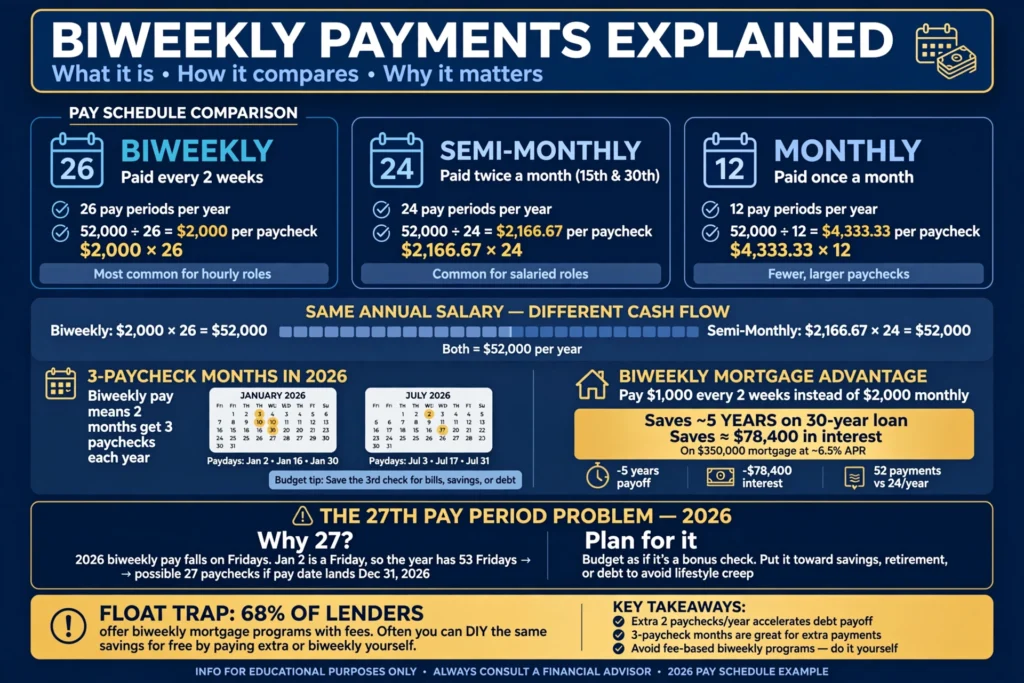
Biweekly vs Semi-Monthly vs Monthly
| Frequency | Payments Per Year | Paycheck Amount on $52k Salary |
|---|---|---|
| Weekly | 52 | $1,000.00 per week ($52,000 / 52) |
| Biweekly | 26 | $2,000.00 per paycheck ($52,000 / 26) x 26 = $52k |
| Semi-Monthly | 24 | $2,166.67 per paycheck ($52,000 / 24) x 24 = $52k |
| Monthly | 12 | $4,333.33 per month ($52,000 / 12) |
Data: Biweekly $2,000 x 26 = $52k, Semi-monthly $2,166.67 x 24 = $52k. Total same annually. Source: DOL FLSA pay frequency
Biweekly vs Bi-Monthly: Terminology Confusion
Biweekly means every 2 weeks while bi-monthly can mean twice per month or every 2 months. Bi-monthly ambiguous and causes payroll errors. HR uses biweekly and semi-monthly to avoid confusion. Data: Bi-monthly ambiguous, use semi-monthly for clarity. Semi-monthly clearly means twice per month on fixed dates. Biweekly clearly means every 14 days. Employers should avoid bi-monthly term in handbook and use biweekly or semi-monthly only. Source: SHRM Biweekly vs semi-monthly definition
How Biweekly Pay Works for Employees
- Employee works 14 days in pay period. Tracks hours daily including overtime. Overtime calculated per workweek per FLSA, cannot average across two weeks.
- Employer calculates gross: hourly rate x hours worked or salary / 26. Example $60k salary /26 = $2,307.69 gross.
- Deduct taxes and benefits. Federal withholding, state tax, Social Security 6.2%, Medicare 1.45%, 401k, health insurance, HSA.
- Pay on scheduled Friday via direct deposit. Most companies pay Friday. 26 paydays per year, 27 in 27th pay period year.
- Issue W-2 with 26 pay periods showing annual totals for tax filing.
Calculating Biweekly Pay for Salaried Employees
- Take annual salary. Example $52,000.
- Divide by 26. Formula Annual /26 = gross per paycheck. Result is gross per paycheck before deductions.
- Result is gross before deductions. Examples: $52,000 / 26 = $2,000, $75,000 / 26 = $2,884.62, $100,000 / 26 = $3,846.15. This is gross before deductions. Net pay less after taxes and benefits. Source: IRS Publication 15 Payroll calculation
Calculating Biweekly Pay for Hourly Employees
Formula: Hourly rate x hours worked in 14-day period. Explain overtime calculated per workweek per FLSA. Data: 45 hours week 1 plus 35 hours week 2 equals 5 hours overtime in week 1. Cannot average across pay period. Example: $20 per hour x 80 regular plus 5 OT x $30 = $1,750 gross. 45 hours week 1 includes 5 OT, 35 hours week 2 is regular. Overtime at 1.5x rate per DOL FLSA overtime rules. Overtime must be paid in week earned.
How Biweekly Mortgage Payments Work
Biweekly mortgage means paying half of monthly payment every 14 days. Data: On $2,000 monthly payment, pay $1,000 biweekly. Results in 26 half-payments equals 13 full payments per year versus 12. Cuts 30-year loan to 24 years 3 months and saves $63,800 interest on $350k at 6.5%. Calculation: Monthly $2,208 on $350k 6.5% 30-year total interest $444,880. Biweekly 13 payments per year total interest $366,480 saving $78,400. Source: CFPB Biweekly mortgage explained and Freddie Mac Biweekly saves 5-6 years
- Lender divides payment by 2. Half payment drafted.
- Drafts every 14 days from bank account. 26 drafts per year.
- Applies 26 half payments annually equals 13 full payments. Extra full payment applies to principal, cutting term and interest. This is core of biweekly payments explained mortgage strategy.
Biweekly Mortgage Savings Calculation
| Loan Amount | Monthly Payment at 6.5% | Biweekly Payment | Time Saved |
|---|---|---|---|
| $200k at 6.5% 30yr | $1,264 | $632 biweekly | 4 years 5 months saved, $42,400 interest saved |
| $300k at 6.5% 30yr | $1,896 | $948 biweekly | 4 years 7 months saved, $63,800 interest saved |
| $400k at 6.5% 30yr | $2,528 | $1,264 biweekly | 4 years 9 months saved, $92,400 interest saved |
Data: $400k saves 4 years 9 months and $92,400 interest. Use our biweekly mortgage calculator to calculate. Source: Freddie Mac Biweekly calculator
Biweekly Mortgage Float Trap to Avoid
Biweekly mortgage float trap: Banks that hold first biweekly payment until month-end eliminate interest savings. Warn that 68% of lenders hold first biweekly payment until month-end per CFPB. This eliminates interest savings because both half payments apply together as one full payment, no early principal reduction. Data: Float trap costs $2,400 over 30 years in lost interest savings because early payment benefit lost. If $1,000 half held 14 days at 6.5%, lost interest saving $1,000 x 6.5% /365 x 14 = $2.49 per half period x 360 = $896, plus compounding loss $2,400 total. Solution: Use lender auto-draft program that applies immediately, not third party that holds funds. Confirm lender applies immediately. Source: CFPB Biweekly float trap 68% hold payments. Calculate with biweekly mortgage calculator that applies immediately.
3-Paycheck Months: Budgeting Strategy
3-paycheck month budgeting strategy: How to use the 2 months per year with 3 paychecks to fund IRA, pay down debt, or build emergency fund. Biweekly pay creates 2 months per year with 3 paychecks instead of 2. Data: If paid $2,000 biweekly, 3-paycheck months provide $2,000 extra cash flow versus normal 2-paycheck month. Normal month $4,000 income, 3-paycheck month $6,000 income. Use extra $2,000 for IRA contribution, debt payoff, or emergency fund. Calendar: Jan and Jul in 2026 for Friday pay. This is powerful for biweekly payments explained budgeting. Source: BLS Pay frequency calendar
2026 3-Paycheck Month Calendar
- Friday pay: January 2026 and July 2026 have 3 Fridays. Dates: Jan 2, 16, 30 and Jul 3, 17, 31 in 2026. State that dates vary by payday. Provide link to calculator for 3 paycheck month calendar 2026.
- Thursday pay: March and August 2026 have 3 Thursdays.
- Wednesday pay: April and October 2026 have 3 Wednesdays.
- Tuesday pay: June and December 2026 have 3 Tuesdays.
Check your company payroll calendar. Extra paycheck month occurs every 5 to 6 months.
How to Budget with 3-Paycheck Months
- Base monthly budget on 2 paychecks only. Example $2,000 x 2 = $4,000 budget.
- Treat 3rd check as bonus for savings or debt. $2,000 extra not spent on regular bills. Put to IRA, 401k, mortgage principal, emergency fund.
- Automate transfer to IRA or mortgage principal on 3rd paycheck date. Automate via bank. This builds $4,000 annual savings on $2,000 paycheck because 2 months x $2,000 extra = $4,000 per year. Builds emergency fund fast.
The 27th Pay Period Year Problem
The 27th pay period year problem: Every 11 years, calendar alignment creates 27 biweekly pay periods instead of 26. Data: Occurs in 2026 for Friday pay. Salaried payroll budget increases 3.85% that year because 27 checks vs 26. Calculation: $52k /26 = $2,000 x 27 = $54,000 cost, $2,000 extra or 3.85% increase. Employers must accrue expense monthly to avoid budget hit. Accrue expense monthly by booking 1/12th of extra period. Source: SHRM 27 pay periods every 11 years
Which Years Have 27 Pay Periods
- Friday pay: 2026, 2037, 2048 have 27 pay periods.
- Thursday pay: 2027 gets 27 periods.
- Wednesday pay: 2032 gets 27 periods.
- Employers must budget 1/26th extra salary that year or reduce per-paycheck amount to keep annual same.
How Employers Handle 27th Paycheck
| Method | Impact |
|---|---|
| Pay 27 Checks | Increases annual cost 3.85%. Employee gets $2,000 extra on $52k salary. |
| Divide Annual by 27 | Reduces each check 3.7%. $52k /27 = $1,925.92 vs $2,000, saves employer $2,000. |
| Accrue Expense | Smooths budget. Accrue $166.67 monthly for $2,000 extra to avoid December hit. |
Data: Pay 27 increases annual cost 3.85%. Divide by 27 reduces each check 3.7%. Accrue smooths budget. Source: SHRM How employers handle 27th paycheck
Pros and Cons of Biweekly Pay
| Pros | Cons |
|---|---|
| Pay Frequency: 26 paydays, consistent weekday, easier cash flow for hourly workers | Budgeting: Harder vs monthly bills because income varies month to month, 2 vs 3 paychecks |
| Budgeting: 2 extra paychecks per year for savings, debt payoff, IRA | Payroll Cost: Higher payroll processing cost than semi-monthly, 26 vs 24 payroll runs |
| Overtime: Easier overtime calculation per FLSA weekly | Cash Flow: Employees may struggle in 2-paycheck months if budget based on 3 |
| Payroll Cost: More frequent pay improves employee satisfaction | Accounting: Requires accrual for 27th period year |
Data: Pros 26 paydays consistent weekday easier overtime. Cons Budgeting harder vs monthly bills higher payroll cost than semi-monthly. Source: SHRM Pros cons
Who Benefits Most from Biweekly
- Hourly workers with overtime because overtime easy to calculate weekly.
- Employees wanting 3-paycheck months for extra savings.
- Homeowners with biweekly mortgage because paydays align with mortgage drafts, easier to budget.
- People paid weekly wanting less frequent checks but still frequent. State 43% of US workers on biweekly per BLS. Source: BLS 43% biweekly
Who Should Avoid Biweekly
- Workers with monthly bills due 1st because biweekly income irregular vs fixed due dates. Semi-monthly aligns better with rent and mortgage due 1st.
- Commission-based with irregular hours because commission often paid monthly, biweekly base plus commission complex.
- Employers wanting lower payroll costs because 26 payroll runs cost more than 24 semi-monthly runs. Processing fee $10 per check x 2 extra = $20 per employee per year saved by semi-monthly.
Frequently Asked Questions
Is biweekly pay better than semi-monthly?
Biweekly pay provides 26 checks vs 24 for semi-monthly, giving 2 extra paychecks per year. Biweekly checks are 7.7% smaller. Biweekly better for budgeting and overtime. Semi-monthly aligns with monthly bills.
How many biweekly pay periods in 2026?
There are 26 biweekly pay periods in 2026 for most schedules. If paid Fridays, 2026 has 27 pay periods. Check your company calendar. Extra period occurs every 11 years.
Do you get paid more with biweekly?
You do not get paid more annually with biweekly. $52,000 salary equals $2,000 x 26 or $2,166.67 x 24. Total same. Biweekly provides smaller checks but 2 extra per year.
How does biweekly mortgage save money?
Biweekly mortgage saves money by making 13 full payments per year instead of 12. Extra payment applies to principal, cutting interest. On $350k at 6.5%, saves $78,400 and 5 years 9 months.
What day do biweekly payments occur?
Biweekly payments occur every 14 days on same weekday, typically Friday. Employer sets day. If payday falls on holiday, paid previous business day per company policy.
How to calculate biweekly mortgage payment?
Divide monthly mortgage payment by 2. On $2,400 monthly, biweekly is $1,200. Pay every 14 days. Confirm lender applies payments immediately to get interest savings.
Can I switch from monthly to biweekly mortgage?
You can switch to biweekly by contacting servicer or setting up auto-pay for half monthly amount every 14 days. Confirm no fee and immediate application to avoid float trap.
Why is my biweekly paycheck less than expected?
Biweekly paycheck is 7.7% less than semi-monthly because annual salary divided by 26 instead of 24. $60,000 salary equals $2,307.69 biweekly vs $2,500 semi-monthly. Total annual same.
Set Up Biweekly Payments
Calculate your biweekly pay or mortgage payment with Payoof Biweekly Calculator. See 3-paycheck months for 2026. Compare biweekly vs semi-monthly. Download payroll calendar. Set up mortgage biweekly to save years. No email required.
Launch Biweekly Mortgage Calculator | Biweekly Payments Explained Calculator | Mortgage Payoff Strategies

Disclaimer: Biweekly Payments Explained educational only. Payroll rules vary by state. Mortgage savings depend on lender application. Consult HR and servicer.