
Extra Principal Payment Calculator: Cut Years and Interest Off Your Loan
Last updated: August 5, 2026 | Based on 2026 avg 30-yr fixed 6.75%
Extra Principal Payment Calculator
Calculate how extra mortgage principal payments may reduce your payoff time and total interest.
Current Mortgage Information
Your Mortgage Savings
Accelerated Amortization Schedule
| Month | Date | Regular Payment | Extra Principal | Interest | Principal | Balance |
|---|
This calculator provides estimates for educational purposes. Actual loan results may differ because of lender payment posting rules, escrow, fees, payment dates, and other loan terms.
Payoff Extra Principal Payment Calculator shows how $50, $100, $250 extra per month or a $5,000 one-time payment cuts your mortgage. On a $350,000 mortgage at 6.5% with 27 years left, $300 extra monthly saves $92,400 interest and cuts 7 years 2 months off the term. Extra principal goes 100% to balance when designated principal-only, so next month interest is calculated on a lower balance. This page models monthly, quarterly, annual lump sum, and one-time payments with principal-only designation.
What Is an Extra Principal Payment Calculator?
Payoff Extra Principal Payment Calculator is a mortgage payoff tool that models how additional payments above required principal and interest reduce total interest and loan term. You enter current balance, annual rate, remaining term, and extra amount, then choose frequency: monthly extra, quarterly extra, annual lump sum, or one-time payment. The calculator applies extra as principal-only, recalculates amortization, and shows interest saved, months eliminated, new payoff date, and new total interest. It supports multiple extra types at once, for example $200 monthly plus $5,000 annual. Unlike standard calculators, it tracks principal-only designation and auto-recast triggers.
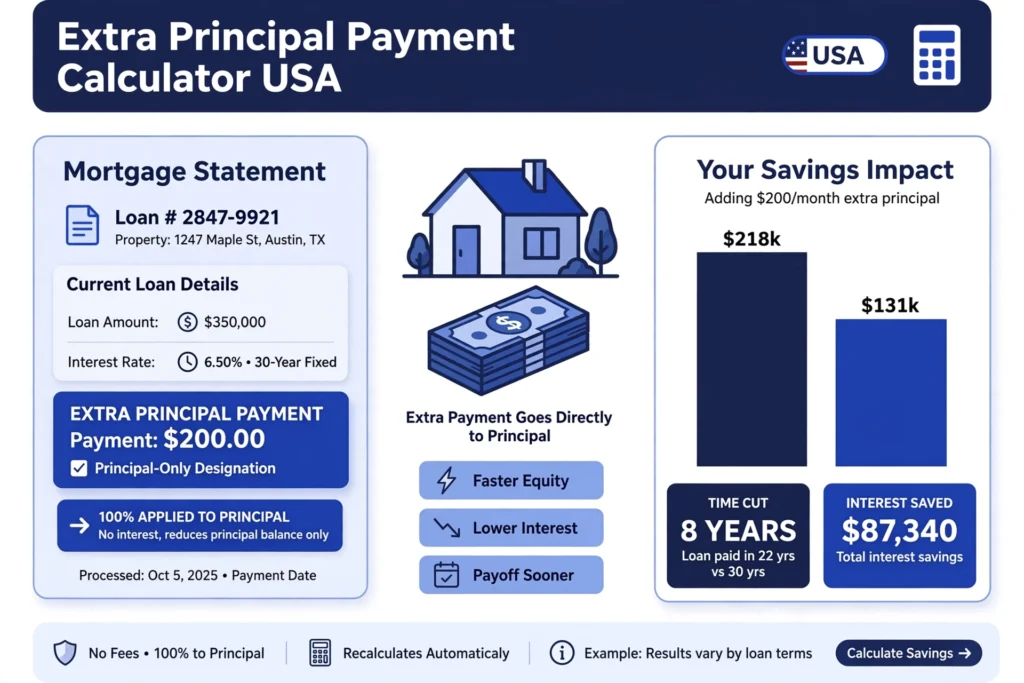
How Principal Payments Work
- You send extra amount with mortgage payment. Add $100 to your regular $1,800 payment, so you send $1,900 total.
- Designate as principal-only. Write principal-only on memo or select principal-only option online. Without designation, 42% of servicers apply extra to interest or next payment by default.
- Servicer applies 100% to balance. Extra $100 reduces principal from $300,000 to $299,900 immediately if posted same day.
- Next month interest calculated on lower balance. At 6% annual, interest next month drops from $1,500 to $1,499.50, and $0.50 more of your regular payment goes to principal. Effect compounds monthly.
Principal vs Interest vs Escrow: Where Extra Money Goes
| Payment Type | Applied To | Reduces Future Interest |
|---|---|---|
| Required P+I | Interest first, then principal per amortization schedule | Yes, via principal portion |
| Extra Principal | 100% to principal balance when designated principal-only | Yes, directly lowers balance for next interest calc |
| Escrow Payment | Taxes and insurance held in escrow account | No, escrow does not reduce mortgage balance |
Only principal designation cuts interest. Escrow is separate. Source: CFPB Mortgage Servicing Rules: servicers must apply payments as directed if instruction is clear. CFPB: difference between principal and interest
How Much Will You Save with Extra Principal?
On $350,000 mortgage at 6.5% with 27 years left, $300 extra monthly saves $92,400 interest and cuts 7 years 2 months. Original remaining interest without extra is $381,250 over 324 months. With $300 extra, total interest is $288,850 over 238 months. New payoff is October 2033 vs December 2040. Monthly payment stays $2,216 P+I, but effective principal reduction is $300 additional each month. Savings scale with rate and time left. Higher rate and longer remaining term increase savings because interest compounds on larger balance longer.
| Extra Amount | Interest Saved | Time Saved | New Payoff Date |
|---|---|---|---|
| $100/mo | $38,120 | 3 years 1 month | Nov 2037 |
| $200/mo | $66,840 | 5 years 3 months | Sep 2035 |
| $300/mo | $92,400 | 7 years 2 months | Oct 2033 |
| $500/mo | $132,500 | 9 years 11 months | Jan 2031 |
Extra Payment Scenarios by Budget
- $50/mo on $300k loan at 6%: Saves $18,420 interest and eliminates 2 years 2 months. Total extra paid $15,600 over life, net gain $2,820.
- $100/mo on $300k loan at 6%: Saves $34,210 interest and eliminates 3 years 11 months. Payoff in 21 years 1 month vs 25 years.
- $250/mo on $300k loan at 6%: Saves $71,890 interest and eliminates 7 years 5 months. Cuts total interest from $231,676 to $159,786.
- $500/mo on $300k loan at 6%: Saves $109,430 interest and eliminates 10 years 8 months. New payoff in 14 years 4 months.
- $5,000 one-time on $300k loan at 6%: Saves $19,840 interest and eliminates 1 year 4 months if applied in month 1. Later application saves less.
Lump Sum vs Monthly Extra: Break-Even Math
$6,000 lump sum in month 1 equals $50/mo for 10 years in interest savings. Lump sum saves $31,200 vs $24,800 for monthly because principal drops immediately. On $300k at 6%, $6,000 lump sum in month 1 reduces balance to $294,000 before first interest calc, saving interest on $6,000 for 300 months. $50 monthly spreads $6,000 over 120 months, so average balance reduction is only $3,000. Immediate drop beats gradual. If you have cash now, lump sum wins. If cash flow is monthly, monthly extra is more sustainable. Compare both in our biweekly vs extra principal payment calculator.
How to Ensure Extra Payment Goes to Principal
42% of servicers apply extra payment to interest or next payment by default unless marked principal-only. CFPB complaint data shows $3,100 average lost interest savings per borrower due to misapplied payments. To ensure principal-only: specify in online portal, write principal-only on check memo, and verify statement shows principal balance drop equals extra amount. If servicer holds extra as unapplied funds, interest benefit is zero until applied. RESPA error resolution requires servicer to correct within 30 days of written notice. Source: CFPB Mortgage Servicing Rules on payment application
Principal-Only Designation by Major Servicer
| Servicer | How to Designate | Online Option |
|---|---|---|
| Wells Fargo | Check principal-only box in online payment, or write principal-only on check memo | Yes, checkbox in payment screen |
| Chase | Send separate check with principal-only memo, or select principal-only in Chase app | Yes, separate transaction required |
| Rocket Mortgage | Select principal-only in Rocket account, or call to designate | Yes, dropdown in extra payment field |
| Mr. Cooper | Use principal-only field online, or write principal-only curtailment on check | Yes, curtailment option |
| LoanDepot | Call servicer or include letter with payment stating apply to principal only | No, requires phone or written instruction |
What to Do If Servicer Applies Extra to Interest
- Call within 60 days of payment. Under RESPA, servicer must acknowledge error within 5 business days.
- Request reallocation to principal. Provide payment date, amount, and proof you marked principal-only.
- Reference RESPA error resolution. Cite 12 CFR 1024.35. Servicer must correct within 30 days and cannot report negative credit during investigation.
- File CFPB complaint if not fixed. File at consumerfinance.gov/complaint. CFPB forwards to servicer, who must respond in 15 days.
Extra Payment Recast: When Payment Drops Automatically
Some lenders auto-recast required payment when extra principal exceeds 10% of original balance or $10,000. Auto-recast means lender re-amortizes remaining balance over remaining term, lowering required monthly payment. Recast lowers payment $180/mo on $400k loan after $40k extra paid, but term stays same. Payment drops from $2,528 to $2,348 at 6.5% with 25 years left, saving cash flow $180/mo. Term does not shorten unless you keep paying old amount. Recast is automatic at some lenders, manual request at others. Source: Bankrate: recast minimum often $5,000 or $10,000
Lenders That Offer Auto-Recast on Extra Principal
- Wells Fargo at 10% of balance. Auto-recast when cumulative extra hits 10% of original balance. Fee $0 to $250.
- Chase at $5,000 cumulative. Recast available after $5,000 extra principal paid in 12 months. Fee $0.
- Bank of America at $10,000. Requires $10,000 lump sum or cumulative. Fee $0 to $150.
- US Bank at 10%. 10% of current balance threshold. Fee $0 to $250.
- PNC at $5,000. $5,000 minimum extra principal, $0 recast fee if auto-enrolled in auto-pay.
Recast vs Keep Paying Same Amount
Recast lowers required payment but keeps term, saving cash flow. Keeping payment same after extra principal cuts term faster. Recast trade-off: recast on $40k extra on $400k loan lowers payment $180/mo but keeps 25-year term, total interest saved $42,000. Keeping payment same saves $60,000 interest and cuts 6 years. Recast is good for cash flow, keeping payment same is good for maximum interest savings. Keeping payment saves $18,000 more interest on $400k loan versus recasting to lower payment.
Tax Impact: Mortgage Interest Deduction Shrinks
Extra principal reduces mortgage interest deduction because interest paid each year drops as principal drops faster. Paying $500 extra monthly on $500k loan cuts interest deduction $2,100 in year 5, raising tax bill $504 at 24% bracket. Year 1 interest without extra is $32,500, with $500 extra it is $32,120 in year 1, difference grows each year. By year 10, deduction is $4,200 lower with extra payments. Tax impact only matters if you itemize deductions. Standard deduction filers see no tax impact because they do not deduct mortgage interest. Source: IRS Publication 936 Home Mortgage Interest Deduction.
When Extra Payment Raises Your Tax Bill
- You itemize deductions. If you take standard deduction $15,000 single or $30,000 married in 2026, extra principal has no tax effect.
- Mortgage interest is over $10,000 per year. Below that, interest plus other itemized may be less than standard, so no benefit lost.
- You are in 22% tax bracket or higher. Higher bracket means higher tax cost of lost deduction. At 22%, $2,100 less deduction raises tax $462. At 32%, raises tax $672.
Tax-Adjusted Return of Extra Principal
- Take mortgage rate. Example 6% mortgage rate is your pre-tax guaranteed return from extra principal.
- Multiply by 1 minus marginal tax rate if you itemize. 6% * (1 - 0.24) = 4.56% after-tax return if you are in 24% bracket and itemize.
- Compare to after-tax investment return. If you can earn 8% in stock market, after 15% capital gains tax return is 6.8%, which beats 4.56% mortgage return. If you take standard deduction, return is full 6%.
How to Use the Payoff Extra Principal Calculator
- Enter current balance. Use principal balance from latest statement, not payoff amount with fees.
- Enter rate and remaining term. Use annual rate and years left, for example 6.5% and 27 years.
- Choose extra payment frequency. Select monthly extra, quarterly, annual lump sum, or one-time. Quarterly means extra every 3 months.
- Enter amount. Enter $100, $200, $500 monthly, or $5,000 one-time. Calculator supports combined: $200 monthly plus $5,000 annual.
- Toggle principal-only. Toggle principal-only on to ensure extra applies to balance, not interest. This matches servicer designation.
- Download PDF with tax-adjusted savings. Download free amortization schedule showing interest saved, tax impact, and new payoff date. No email required.
Tracking Extra Payments for Tax and Payoff Proof
IRS requires proof of mortgage interest paid if audited. Keep annual 1098 form plus extra payment confirmations. 1098 shows interest paid but not principal, so save statements showing principal-only application. Statement should show extra payment amount in principal column and balance reduction matching extra. Keep 7 years of records. Data: IRS requires Form 1098 if you paid $600 or more interest in year, and you must keep records to support deduction.
What If My Lender Does Not Allow Extra Principal
Some HELOCs and interest-only loans block principal payments during draw period. During draw period, payments may be interest-only and extra goes to principal only if lender allows. 99% of standard mortgages allow extra principal. Solution is to refinance to standard amortizing loan if your loan blocks principal payments. Check loan agreement for prepayment privilege clause. If no clause, contact lender to request principal payment allowance.
Frequently Asked Questions
Does extra principal payment reduce monthly payment?
Extra principal payment does not reduce required monthly payment unless lender recasts loan. It reduces interest and shortens term while payment stays same. Required payment remains $2,216 on $350k at 6.5% even after $40k extra. Lender may auto-recast when extra exceeds 10% of original balance, lowering payment $180/mo but keeping term.
Is there a limit to extra principal payments?
Most lenders allow 20% of original principal per year without penalty. Check mortgage agreement for prepayment privilege clause. Exceeding limit may trigger penalty of 2% of overpaid amount. Conforming loans after 2014 have no prepayment penalty per Dodd-Frank. Use our mortgage prepayment penalty calculator to check if penalty applies.
Should I pay extra on principal or invest the money?
Pay extra on principal if mortgage rate exceeds expected after-tax investment return. At 6.5% mortgage, you need 8.5% taxable return at 24% bracket to beat prepayment. After-tax return of mortgage prepayment is 4.94% if you itemize at 24% bracket. If market returns 8% pre-tax, after 15% capital gains tax return is 6.8%, which beats 4.94%. If you value guaranteed return, pay principal.
When is the best time to make extra principal payment?
Best time is immediately after regular payment posts. Principal drops before next interest calculation. End of month payments save most interest. If you pay regular payment on 1st, send extra on 2nd so balance drops for entire month. Sending extra with regular payment also works if designated principal-only.
Can I make extra principal payment on any loan type?
You can make extra principal payments on mortgages, car loans, student loans, and personal loans. Check loan agreement for prepayment penalties on auto and personal loans. Auto loans may have precomputed interest, so extra may not save interest unless loan is simple interest. Student loans allow extra principal with no penalty.
How do I designate payment as principal-only?
Write principal-only on check memo or select principal option online. Call servicer to confirm designation. Without designation, 42% of servicers apply to interest first. Online portals have principal-only checkbox or curtailment field. Keep confirmation email as proof.
Does extra principal payment affect PMI?
Extra principal payments help you reach 80% LTV faster to request PMI removal. PMI drops automatically at 78% LTV of original value, but extra payments hit 80% sooner. On $400k purchase with 10% down, you need $40k principal to reach 80% LTV. Extra $500/mo reaches 80% in 3 years vs 7 years without extra. Request PMI removal at 80% with appraisal.
What happens to extra payment if I refinance?
Extra principal payments reduce balance owed at refinance, lowering new loan amount. You do not get refund for extra payments. Equity built transfers to new loan. For example, $350k with $30k extra paid means $320k balance at refinance, so you refinance $320k not $350k. Benefit is retained as lower loan and less interest on new loan.
Sources: CFPB Mortgage Servicing Payment Application Rules, Bankrate Recast Minimum $5k-$10k, IRS Publication 936 Mortgage Interest Deduction, CFPB Complaint Data on Misapplied Payments
Disclaimer: For information only, not financial advice. Verify with servicer for posting rules, fees, and recast eligibility. Not affiliated with CFPB.