Should You Pay Off Early? Pros, Cons, and When It Makes Sense
Should you pay off early depends on interest rate, penalties, emergency fund, and what else you could do with cash. If rate is high, no penalty, and you have 6 months savings, early payoff saves thousands in interest and gives peace of mind. If rate is low and you can invest for higher return, keeping loan may be smarter. This guide breaks down pros, cons, costs, credit impact, and a decision matrix.
Can You Pay Off a Loan Early?
Yes you can pay off most loans early, called prepaying. Most US residential mortgages, personal loans, auto loans allow extra payments or full payoff before term ends. You need payoff statement showing principal, interest through payoff date, fees, and per diem interest. Request from servicer. Some loans have prepayment penalty if note includes one, but QM rules ban penalties on most mortgages originated after 2014. Source: CFPB What is a prepayment penalty. Paying early reduces interest and frees budget but reduces liquidity. Learn how to manage payoff with managing your loan debt strategies.
Pros and Cons of Paying Off Early
| Pros | Cons |
|---|---|
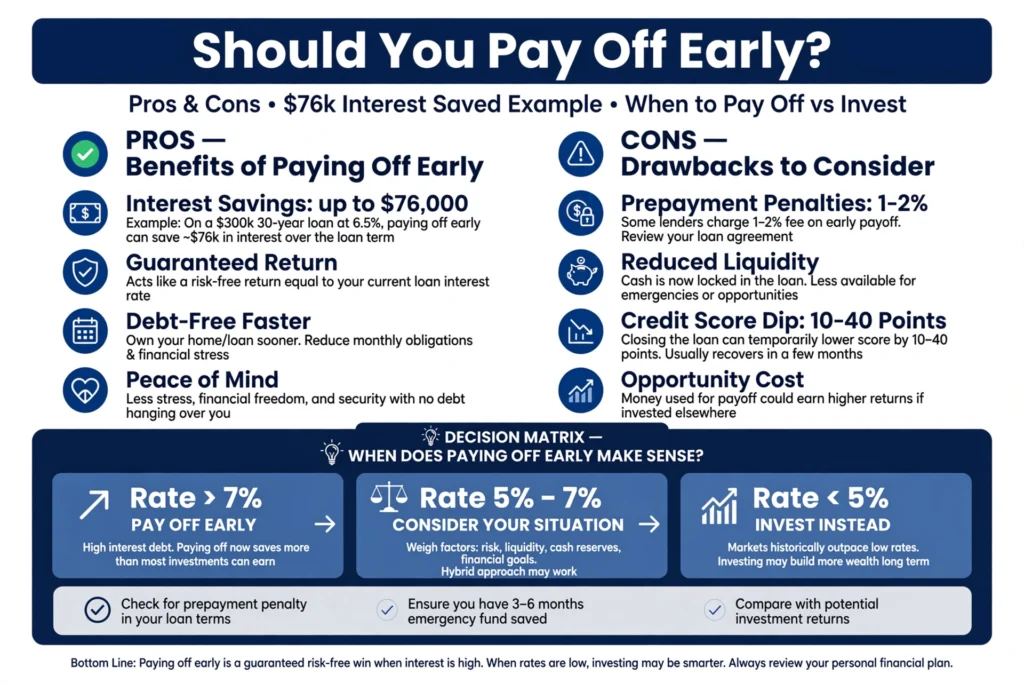
| Financial Benefit: Save interest for remaining term. On $300k at 6% with 15 years left, early payoff saves $165,000 future interest | Drawback: Loss of liquidity. Cash tied in home equity harder to access than brokerage account |
| Interest Saved: Guaranteed risk free return equal to mortgage rate. 6.5% rate equals 6.5% guaranteed return | Prepayment Penalty: Some loans charge 1% to 2% of balance if paid within 2 to 3 years |
| Cash Flow: Frees $1,500 to $2,500 monthly for investing or expenses. Improves debt to income for next loan | Less liquidity: Emergency fund may drop if you use all cash to payoff |
| Credit: Shows low debt long term, improves debt to income. Temporary dip 10 to 40 points then recovery | Temporary dip: Credit mix changes when installment closes, may drop 10 to 40 points for 2 to 3 months |
| Peace of mind: 67% cite peace of mind as top reason per Federal Reserve SCF | Missed investment: If market returns 8% plus, investing may beat 5% mortgage payoff mathematically |
Source: Federal Reserve Survey of Consumer Finances – peace of mind reason and Experian Paying off mortgage early impact
How Much Interest Do You Save by Paying Off Early?
Interest saved equals interest you would have paid for remaining months. Formula: Interest Saved = Sum of future interest without extra minus sum with extra. You also cut term.
Formula: Monthly Payment = [P x r x (1+r)^n]/[(1+r)^n -1]. Then extra principal reduces balance, next interest = (Old Balance – Extra) x r. This changes principal and interest breakdown so more goes to principal.
Example: £250k mortgage at 5% with 20 years left (240 months), payment £1,649. With £5k lump now, interest saved £11,970 and term cut 1 year 4 months. Calculation: Without extra total interest £145,760. With £5k extra total interest £133,790. Saving £11,970. Same in dollars: $250k at 5% saves $11,970. Larger example: $300k at 6% 30-year, add $500 extra monthly saves $76,421 interest and cuts 8 years 4 months. Source: Freddie Mac Mortgage Prepayment savings and CFPB Amortization schedule
Use our early payoff calculator to see your exact savings. Enter loan amount, rate, extra lump or monthly.
The Costs of Paying Off Early
Three costs to consider before you decide should you payoff early:
- Prepayment penalties: Fee if note includes penalty clause. Typically 2% of balance in year 1, 1% in year 2. On $300k loan penalty = $6,000 in year 1. Most QM loans ban this after 2014. Check note. Source: CFPB QM Rule 1026.43 – No prepayment penalty on QM loans
- Opportunity cost: Money used to payoff could earn higher return elsewhere. If mortgage 6% and market expected 8%, paying off costs 2% potential gain. Example: $10k extra to 6% mortgage saves $600 per year. Same $10k in market at 8% earns $800, $200 more.
- Loss of tax deduction: If you itemize, mortgage interest reduces taxable income. Paying off eliminates deduction. At 24% bracket, $10k interest saves $2,400 tax. Without mortgage you lose that saving. Standard deduction filers not affected.
Prepayment Penalties and Fees
Prepayment penalties are early repayment charges. Lenders must disclose in closing docs under TILA. Federal law bans penalties on FHA, VA, USDA, and QM loans after 2014. Conventional investment loans may still have. Limits: Penalty cannot exceed 2% of balance in first 2 years under old rules. Many states ban entirely. Check your promissory note for prepayment rider. Request payoff statement to confirm no fee.
Opportunity Cost – Pay off vs Invest
Opportunity cost is return you give up by choosing payoff over investing. If you decide should you payoff early vs invest, compare guaranteed mortgage rate to expected after-tax investment return.
Example: Mortgage 6%, marginal tax 24% and you itemize. After-tax cost = 6% x (1-0.24) = 4.56%. If market expected 8% after tax, investing wins by 3.44%. If market expected 5% and mortgage 6%, payoff wins. Historical S&P 500 average 10% before inflation, 7% after. But market volatile. Payoff is risk free. Decision depends on risk tolerance and horizon. Learn more in pay off debt or invest analysis and payoff vs investing scenario. Source: Vanguard Pay off debt vs invest trade off
Should You Pay Off High Interest Debt First?
Yes you should pay off high interest debt first before low rate mortgage. Priority order list:
- 401k match up to employer max – 50% to 100% instant return beats any debt. Source: DOL 401k match
- Credit card at 17% to 24% APR – Costs $170 to $240 per $1,000 per year. Pay first. Source: Federal Reserve G19 Average credit card APR 21% 2024
- Personal loan at 10% to 15% APR
- Emergency fund 6 months expenses in high yield savings 4% plus
- Auto loan at 7% to 9%
- Mortgage at 3% to 7% last because rate lowest and collateral is home
Mortgage 3% costs $30 per $1,000 per year vs credit card 17% costs $170. Pay high rate first saves most interest. Should you payoff early on mortgage only after high interest cleared.
Does Paying Off Early Hurt Your Credit Score?
Paying off early causes a minor temporary dip of 10 to 40 points because installment loan closes, credit mix changes, average age shortens. FICO counts mix of revolving and installment. When mortgage closes, you lose installment diversity. Also total accounts drop. Effect lasts 2 to 3 months then recovers as low debt and on time history remain. Long term benefit outweighs dip. If you plan mortgage application soon, avoid closing old loans within 6 months before application. Lenders like to see active mortgage history. Timing matters. Source: myFICO Credit mix and payment history and Experian Paying off mortgage credit impact 10-40 points. Credit score dip is temporary, worth bearing in mind for mortgage application timing.
When Should You Pay Off Early? Decision Framework
| Situation | Action | Why |
|---|---|---|
| Mortgage rate greater than 7% and no high interest debt | Pay off early | 7% risk free return beats expected market 7% after tax. Save interest fast. |
| Rate less than 5% and emergency fund less than 6 months | Save first | Liquidity prevents high cost debt. 4% HYSA plus safety beats low rate payoff. |
| Have credit card at 17% plus and mortgage at 4% | Pay credit card first | 17% return paying card vs 4% mortgage. Card costs 4x more per year. |
| Rate 5% to 7% and have 401k match and emergency fund | Split: 50% extra to mortgage, 50% to invest | Hybrid balances guaranteed return and growth. Reduces risk. |
| Plan to retire in 5 years with mortgage payment $2,000 | Pay off before retirement | Cuts needed withdrawal $24k per year, improves sequence of returns risk. 73% vs 12% failure rate difference. |
| Standard deduction filer, rate 6% plus, 10+ years to retirement | Pay off early if risk averse, invest if aggressive | Standard deduction no tax benefit, so break even equals mortgage rate. Risk free 6% attractive. |
Use this matrix to decide should you payoff early. If rate greater than 7% pay off. If rate less than 5% invest. If between 5% and 7% split. Always keep 6 months emergency fund. Always pay high interest debt first. Source for thresholds: Kitces Should you payoff mortgage early decision framework
Not sure if early payoff is right for you?
Use our early payoff vs invest calculator to compare your exact savings. Enter rate, balance, extra payment, expected return to see break even.
Launch Payoff vs Invest Calculator | Launch Early Payoff Calculator | Extra Principal Guide
Frequently Asked Questions
Is it smart to pay off a loan early?
Yes it can be smart if mortgage rate above 6% and you have 6 months emergency fund, no high interest debt, and no prepayment penalty. You save interest, improve cash flow, reduce risk. If rate under 5% and you can invest at 8% plus, investing may beat payoff.
What are the disadvantages of paying off a loan early?
The main disadvantages are lost liquidity, opportunity cost of not investing, loss of mortgage interest tax deduction, and possible prepayment penalties. Paying off ties up cash in home equity that is harder to access than investments.
Does paying off early hurt credit?
Paying off early causes a minor temporary dip of 10 to 40 points because installment account closes and credit mix changes. Score recovers in 2 to 3 months. Long term benefit of low debt outweighs dip.
Are there penalties for paying off a loan early?
Most mortgages do not have penalties, but some loans include fees. Federal QM rules ban prepayment penalties on most residential mortgages after 2014. Personal loans may charge 1% to 2% if paid within 2 years. Check note.
Should I pay off my mortgage early or invest?
If your mortgage rate is lower than potential investment return, investing may be better. Example: 6% mortgage vs 8% expected market return. After tax, 8% may beat payoff. If rate 7% plus, payoff is risk free 7% return which beats many investments.
How much interest do you save?
You save interest for all remaining months. On a £250k mortgage at 5% with 20 years left, a £5k lump saves £11,970 interest and cuts 1 year 4 months. On $300k at 6% with $500 extra monthly, you save $76,000 and 8 years.
Should I pay off high interest debt first?
Yes, you should pay off high interest debt first. Pay credit cards at 17% to 24% before mortgage at 3% to 7%. High interest costs more per year. Priority: 401k match, high interest debt, emergency fund, then mortgage early payoff.
What happens when you pay off loan early?
When you pay off early, you reduce total interest and free up monthly budget. Lender sends lien release, closes account, and you own asset free and clear. You must pay taxes and insurance directly and credit may dip temporarily then recover.

Disclaimer: Should You Payoff Early content is educational only, not financial advice. Rates, penalties, tax rules, investment returns vary. Consult qualified advisor. External sources linked for authenticity.