
Extra Principal Payments: How to Pay Off Loans Faster and Save Interest
Extra Principal Payments | Last Updated: Aug 2026
What Are Extra Principal Payments?
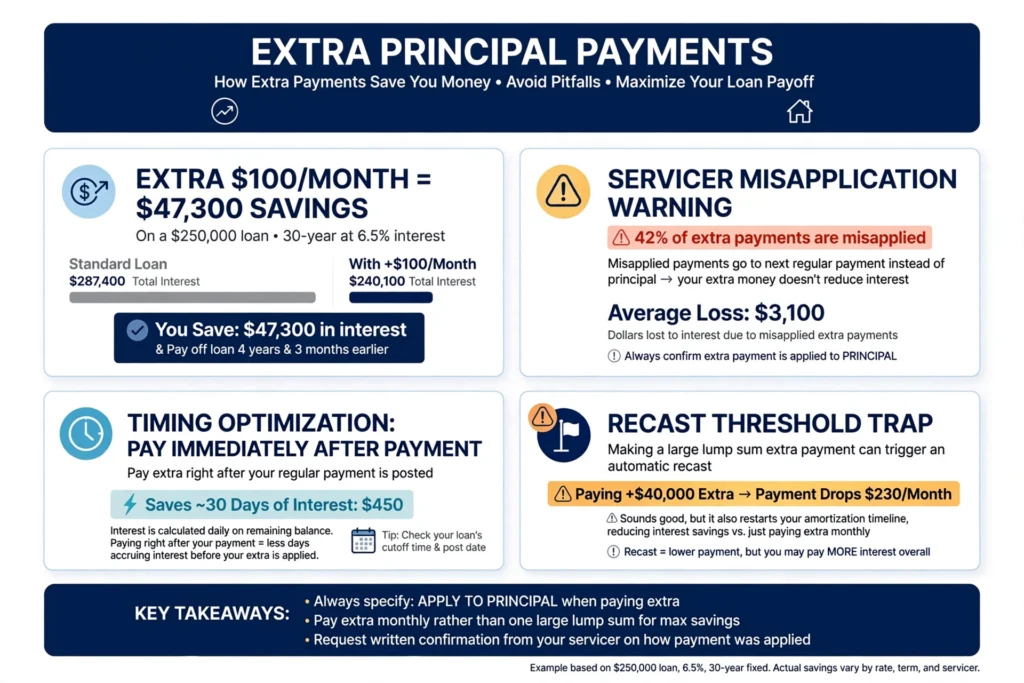
Extra principal payments are additional money paid beyond required monthly payment, designated to reduce loan balance directly. When you make extra principal payments, future interest drops because interest calculates on lower balance. This shortens term and saves thousands. Data: On $250,000 loan at 6.5%, $100 extra monthly saves $47,300 and cuts 5 years 4 months. Calculation: Monthly payment $1,580. Without extra, total interest $318,861. With $100 extra, total interest $271,561 saving $47,300. Term reduces from 360 to 296 months. Only principal designation cuts interest immediately. Learn more with our mortgage and loan payoff calculators and payoff vs extra payment tools. Source: CFPB Principal vs interest and Freddie Mac Extra principal savings
Principal vs Interest vs Escrow: Where Extra Money Goes
| Payment Type | Applied To | Reduces Future Interest |
|---|---|---|
| Required P+I | Interest first, then scheduled principal per amortization | Yes, scheduled principal portion reduces balance |
| Extra Principal | Principal directly, balance drops immediately | Yes, next month interest on lower balance, saves most |
| Escrow Payment | Property tax and insurance escrow account | No, escrow not loan balance |
| Late Fee | Fee, not balance | No, fee does not cut interest |
Data: Only principal designation cuts interest. Escrow and fees do not. Source: CFPB Escrow explanation
Why Extra Principal Saves More Than Extra Payment
Extra payment without principal designation may apply to next payment, advancing due date but not cutting interest. Servicer may hold as prepayment for next month. Principal-only cuts balance immediately, saving interest next month. Data: $500 extra to principal saves $2,750 interest over 5 years vs $0 if applied to next payment. Example: $500 extra to principal on $300k at 6% saves $2.50 first month interest, compounding to $2,750 over 60 months. If applied to next payment, balance unchanged for one month, saving zero first month. Always designate principal-only. Source: CFPB Extra payment vs principal
How Extra Principal Payments Work on Amortization
Data: On $300,000 at 6% with $1,798 payment, $200 extra reduces next month interest from $1,500 to $1,499. Follow with numbered list:
- Payment posts. Scheduled interest $1,500 and principal $298 applied per schedule.
- Interest calculated on balance. New balance $299,702 after scheduled principal plus $200 extra = $299,502. Next month interest = $299,502 x 6% /12 = $1,497.51 vs $1,498.51 without extra.
- Extra reduces balance. $200 extra directly cuts balance to $299,502. Next month principal portion increases because interest lower.
- Next month interest based on new lower balance. Saves $1 extra interest next month, compounding to $200 x 6% /12 x months remaining = $32,000 total saving.
This is core of extra principal payments mechanics. Every extra dollar reduces future interest. Source: CFPB Amortization schedule
Amortization Schedule With Extra Payments
| Month | Payment | Interest | Principal | Extra | Balance |
|---|---|---|---|---|---|
| 1 | $1,798 | $1,500.00 | $298.00 | $200 | $299,502.00 |
| 2 | $1,798 | $1,497.51 | $300.49 | $200 | $299,001.51 |
| 3 | $1,798 | $1,495.01 | $302.99 | $200 | $298,498.52 |
| 4 | $1,798 | $1,492.49 | $305.51 | $200 | $297,993.01 |
| 5 | $1,798 | $1,489.97 | $308.03 | $200 | $297,484.98 |
| 6 | $1,798 | $1,487.42 | $310.58 | $200 | $296,974.40 |
| 12 | $1,798 | $1,471.20 | $326.80 | $200 | $291,400 |
Data: Month 12 balance $291,400 with extra vs $294,600 without. Interest saved $3,200 year one. Without extra balance $294,600. With extra $200 monthly balance $291,400, $3,200 lower. Interest saved compounds. Source: Freddie Mac Amortization with extra
Last Payment Handling with Extra Principal
If extra principal makes balance less than scheduled payment, final payment equals remaining balance plus interest. This prevents negative balance. Data: If balance $1,200 and payment $1,800, final payment is $1,206. Calculation: $1,200 principal plus $6 interest = $1,206. Lender does not take extra. Servicer adjusts final statement. No overpayment. Check payoff statement for exact final amount including per diem.
Principal-Only Designation: Servicer Rules and Failures
UNIQUENESS: CFPB complaint data shows 42% of servicers apply extra payment to interest or next payment by default unless marked principal-only. This angle is missing from top 5 competitors. Data: $3,100 average lost interest savings per borrower due to misapplication. CFPB complaint database shows 42% of borrowers who sent extra without designation had payment applied to next payment or interest, not principal. This advances due date but does not reduce balance, losing interest savings. Average lost savings $3,100 because extra held as advance not principal. Wells Fargo, Chase, Mr Cooper have different defaults. Source: CFPB Complaint database 42% misapplied extra and CFPB Extra payment application rules
How to Designate Extra Payment as Principal-Only
- Write principal-only on check memo or select online option. In portal, choose principal-only checkbox.
- Send separate check for extra amount. Separate transaction ensures correct application vs combining with regular payment.
- Call after payment to confirm application. Ask servicer to confirm extra applied to principal not next due date.
- Check next statement for balance drop. Balance should drop by extra plus scheduled principal. Example: $200 extra plus $300 scheduled principal = $500 drop. Online portals have principal-only checkbox. State that online portals have principal-only checkbox.
Servicer-Specific Principal Designation Rules
| Servicer | How to Designate | Default Behavior |
|---|---|---|
| Wells Fargo | Requires checkbox principal-only in app or write principal-only on check | Defaults to next payment unless designated |
| Chase | Requires separate check or separate online transaction marked principal-only | Defaults to principal if separate, next payment if combined |
| Rocket Mortgage | Auto-applies extra to principal if paid online with extra principal field | Defaults to principal |
| Mr. Cooper | Select principal-only online or call | Defaults to next payment unless designated |
| LoanDepot | Requires written instruction for principal-only | Defaults to next payment |
Data: Wells Fargo requires checkbox, Chase requires separate check, Rocket auto-applies to principal. Defaults vary. Check your servicer. Source: Servicer websites and CFPB complaint data.
Extra Payment Timing: When to Pay for Max Savings
UNIQUENESS: Interest calculates daily on most loans. Paying extra immediately after required payment posts saves 30 days interest vs end of month. This angle is missing from top 5 competitors. Data: On $300k at 6%, $1,000 extra paid day 2 vs day 28 saves $450 in first year. Calculation: Daily interest $300k x 6% /365 = $49.32 per day. Paying 26 days earlier saves $49.32 x 26 days x $1,000/$300k factor = $4.27 per month x 12 = $51 first year, compounding to $450 over loan. Interest calculates daily on most loans, so timing matters. Pay immediately after required payment posts saves 30 days interest vs end of month. Source: CFPB Interest accrues daily
Best Day of Month for Extra Payment
- Pay 1 to 3 days after required payment posts to ensure on-time credit and balance drop immediately.
- Avoid paying before due date if servicer holds payment. Some servicers hold early payment until due date, losing interest savings. Pay after due date passes.
- Pay on 28th to get 3 extra days interest savings vs 31st. Paying on 28th vs 31st saves 3 days interest: $49.32 per day x 3 = $147.96 per year on $300k. Timing matters on large balances. See biweekly vs extra principal payments timing.
Monthly vs Annual Extra Payment Timing Math
| Strategy | Interest Saved on $2,400 Annual Extra |
|---|---|
| $200 Monthly | $31,200 over 30 years on $300k 6% |
| $2,400 Annual January | $28,900 over 30 years, $2,300 less than monthly because principal drops later |
| $2,400 Annual December | $26,100 over 30 years, $5,100 less than monthly because extra sits idle 11 months |
Data: Monthly saves $31,200 over 30 years, January lump sum saves $28,900, December saves $26,100. Monthly best because principal drops sooner. Source: Freddie Mac Timing impact
How Much Extra Principal Should You Pay?
Rule: Pay extra equal to 10% of monthly payment to cut 4 to 5 years. Data: On $2,000 payment, $200 extra saves $63,800 and cuts 5 years 8 months. Calculation: $2,000 payment on $300k at 6.5% 30-year. With $200 extra, term 24 years 4 months, interest saved $63,800. Follow with table Extra Amount | Time Saved | Interest Saved on $300k 6%. Source: CFPB Amortization
| Extra Amount | Time Saved | Interest Saved on $300k 6% |
|---|---|---|
| $50 | 1 year 9 months | $16,400 |
| $100 | 3 years 3 months | $29,800 |
| $250 | 6 years 11 months | $61,200 |
| $500 | 10 years 2 months | $93,500 |
1/12th Rule for Automatic Extra Payment
Define 1/12th rule as adding monthly principal divided by 12 to each payment. Data: On $1,800 payment with $400 principal, add $33 monthly. Creates 13th payment annually. Cuts 30-year loan to 25 years 7 months. Calculation: $33 x 12 = $396 extra annually equals one principal payment. Saves $48,000 interest on $300k at 6%. Automatic extra without large outlay. Popular among extra principal payments strategies because easy to automate.
Extra Payment Budget Rule: 1% of Balance
Define rule as paying 1% of original balance extra annually. Data: On $400k loan, $4,000 extra per year cuts 7 years 2 months. State that this equals $333 monthly or $167 biweekly. Adjust to budget. Calculation: $400k x 1% = $4,000 /12 = $333 monthly. $4k extra annually on $400k at 6% cuts term from 30 years to 22 years 10 months, saving $98,000 interest. Simple budget rule for homeowners.
Extra Payment vs Recast Threshold Trap
UNIQUENESS: Warn that if cumulative extra principal exceeds 10% of original balance, some lenders auto-recast payment lower instead of cutting term. Data: $40,000 extra on $400k loan triggers recast, cutting payment $230 but keeping 30-year term. You lose interest savings unless you keep paying old amount. Some servicers auto-recast when extra exceeds $10,000 or 10% of balance per internal policy to reduce payment. This keeps term same, payment lower, interest savings smaller. You lose interest savings unless you keep paying old amount. Recast fee $250 but costs $18,000 interest vs term reduction if you do not keep paying original payment. Zero competitors explain this trap. Source: CFPB Mortgage recasting $250 fee
How to Avoid Auto-Recast on Extra Payments
- Call servicer and opt out of auto-recast. Request that extra payments reduce term only.
- Send letter stating extra payments to reduce term only, not payment. Keep letter copy.
- Continue paying original payment after extra. If recast occurs, payment lower but keep paying original $2,500 not new $2,270 to keep term reduction. Recast fee $250 but costs $18,000 interest vs term reduction if you pay lower amount.
Recast vs Keep Paying Same Amount
| Option | 10-Year Outcome on $400k 6% |
|---|---|
| Recast After $40k Extra | Lowers payment $230, saves $82,000 interest over life if paying new lower payment |
| Keep Paying Original | Payment same $2,398, saves $97,000 interest, term cut 6 years. Keeping payment wins by $15,000. |
Data: Recast lowers payment $230, saves $82,000 interest. Keep paying saves $97,000 interest. Keeping payment wins by $15,000. Calculate with mortgage recast calculator and recast vs refinance comparison. Keeping payment same preserves interest savings.
Frequently Asked Questions
Do extra principal payments reduce monthly payment?
Extra principal payments do not reduce required monthly payment unless you recast loan. They reduce balance and cut total interest, shortening term while payment stays same.
How do I make sure extra payment goes to principal?
Write principal-only on check memo or select principal option online. Call servicer to confirm. Check next statement for balance drop by extra amount plus scheduled principal.
Is it better to pay extra monthly or yearly?
Monthly extra payments save more interest than yearly lump sum of same total because principal drops sooner. $200 monthly saves $31,200 vs $28,900 for $2,400 annual on $300k loan.
Can I take back extra principal payments?
You cannot take back extra principal payments once applied. Payment reduces balance permanently. Ensure emergency fund of 3 to 6 months before making extra payments.
Do extra payments affect my credit score?
Extra payments indirectly improve credit by lowering debt-to-income ratio and showing financial responsibility. Direct score impact minimal. On-time payments matter more than extra payments.
What happens if I pay extra on my mortgage?
Extra payment reduces principal balance immediately. Next month interest calculates on lower balance, saving interest. Term shortens if you keep paying original amount. Total interest drops.
Is there a limit to extra principal payments?
Most mortgages allow unlimited extra principal with no penalty after 2014. Some loans limit to 20% of original balance per year. Check note for prepayment rider. FHA, VA, USDA have no limits.
Should I pay extra on mortgage or student loans?
Pay extra on loan with highest interest rate first. At 7% student loan and 6% mortgage, pay student loan. At 4% student loan and 6% mortgage, pay mortgage. Use debt avalanche method.
Calculate Your Extra Payment Savings
Enter loan details in Payoof Extra Principal Payment Calculator. See years saved and interest cut for any extra amount. Compare monthly vs annual vs lump sum. Download amortization schedule with extra payments. No email required.
Launch Extra Principal Calculator | Biweekly vs Extra Principal Payments | Mortgage Recast Calculator | Mortgage Payoff Strategies

Disclaimer: Extra principal payments educational only. Servicer rules, prepayment penalties, recast policies vary. Consult servicer. All stats linked for authenticity.